The essentials
This brief sets the five climate targets that the Prime Minister announced at Glasgow on 1 November 2021 beside the Government's own figures five years later. It tests the promise on energy and on electricity generated, and it reads the updated NDC of August 2022 to see which targets it kept. It also sets the Government's own records on polluted air beside those fuels.
NITI Aayog: 87 per cent of primary energy from fossil fuels, 2025
NITI Aayog's overview of February 2026 estimates that fossil fuels supplied 87 per cent of India's primary energy in 2025, and that non-fossil fuels, excluding traditional biomass, supplied 5 per cent. The Prime Minister had promised that India would meet 50 percent of its energy requirements from renewable energy by 2030.
Source: NITI Aayog, February 2026 ; PIB 226227, 1 November 2021 .
71.04 per cent of electricity from fossil fuels, 2025-26
The Central Electricity Authority's year-end table shows that fossil fuels generated 71.04 per cent of India's electricity in 2025-26, the latest closed year. The non-fossil share was 24.90 per cent in 2021-22, and it was 28.96 per cent in 2025-26, which is a rise of 4.06 percentage points in four years.
Source: CEA, RE Generation, March 2026 ; RS Question 836, 11 December 2023 .
17.26 per cent more thermal power, 33.65 per cent more coal
Thermal power stations generated 1,307.13 billion units in 2025-26, which is 17.26 per cent more than the 1,114.71 billion units of 2021-22. Coal production rose from 778.210 million tonnes in 2021-22 to 1,040.08 million tonnes in 2025-26, which is an increase of 33.65 per cent.
Source: CEA, Executive Summary, March 2023 ; CEA, Executive Summary, March 2026 ; Coal Directory 2024-25 ; RS Question 47, 20 July 2026 .
21,993 MW more coal capacity since October 2021
India's coal-based capacity rose from 2,02,414.50 MW on 31 October 2021 to 2,24,407.50 MW on 31 August 2026, as the Central Electricity Authority counts it. On 31 July 2026 the Authority listed 42,700 MW more thermal capacity in its programme to 2031-32, leaving out projects on hold and stressed projects, and it scheduled 16,620 MW of that for 2029-30.
Source: CEA capacity, 31 October 2021 ; CEA capacity, 31 August 2026 ; CEA thermal projects, July 2026 .
The updated NDC: no 500 GW, no one billion tonnes, no target for energy
By 2030, the updated NDC of 3 August 2022 committed India to a 45 percent cut in emissions intensity and to about 50 percent of installed capacity from non-fossil sources. The 500 GW and the cut of one billion tonnes are not in it, and it sets no target for energy; its target of about 50 percent counts installed capacity.
Source: PIB 236437, 3 August 2022 ; RS Question 1816, 22 December 2022 .
What the Prime Minister promised on 1 November 2021
The Prime Minister presented five targets, which he called the Panchamrit, at the COP26 climate summit in Glasgow on 1 November 2021. The Prime Minister's Office published an English text that night and marks it as "the approximate translation of Prime Minister’s remarks", which were delivered in Hindi, and the table quotes each target exactly as that English text gives it.
| What the Prime Minister promised, 1 November 2021 | What the updated NDC of 3 August 2022 says |
|---|---|
| India will reach its non-fossil energy capacity to 500 GW by 2030. | Not in the commitment. The release states the updated commitment as two numerical targets for 2030, and this is not one of them. |
| India will meet 50 percent of its energy requirements from renewable energy by 2030. | No target for energy. The release's target of the same size reads "about 50 percent cumulative electric power installed capacity from non-fossil fuel-based energy resources by 2030". |
| India will reduce the total projected carbon emissions by one billion tonnes from now onwards till 2030. | Not in the commitment. |
| By 2030, India will reduce the carbon intensity of its economy by less than 45 percent. | Kept, as "reduce Emissions Intensity of its GDP by 45 percent by 2030, from 2005 level". |
| by the year 2070, India will achieve the target of Net Zero. | Named as a long-term goal: the release calls the update "a step towards achieving India’s long term goal of reaching net-zero by 2070". |
The left column is the English text of the Prime Minister's statement of 1 November 2021. The right column is the updated commitment that the Cabinet approved on 3 August 2022, as its release states it.
Source: PIB 226227, 1 November 2021 ; PIB 236437, 3 August 2022 .
Energy: 87 per cent from fossil fuels in 2025
NITI Aayog, which is the Government's policy think tank, published its overview of the paths to net zero in February 2026. Primary energy counts the coal, oil, gas, biomass, nuclear fuel, water, wind and sunlight that a country draws on before any of it is converted into electricity or refined fuel. The overview's section on primary energy says: "In 2025, fossil fuels provide 87% of primary energy." The same section marks its total for 2025 as estimated, in the words "Primary energy supply increases from 1,006 Mtoe in 2025 (estimated)", so this brief treats the shares for 2025 as part of that estimate.
| What NITI Aayog measures | NITI Aayog's words, February 2026 |
|---|---|
| Fossil fuels' share of primary energy, 2025 | In 2025, fossil fuels provide 87% of primary energy. |
| Non-fossil share of primary energy, 2025 | "the share of non-fossil fuels in primary energy rises from 5% in 2025 (excluding traditional biomass)" |
| Electricity's share of final energy demand, 2025, NITI Aayog's estimate | "Electricity’s share of final energy demand rises from 21% in 2025" |
| Primary energy supply, 2025 | "Primary energy supply increases from 1,006 Mtoe in 2025 (estimated)" |
Each row quotes NITI Aayog's report of February 2026 word for word. The figures for 2025 are NITI Aayog's estimate, and they are on different bases, so this brief never adds them together.
The same section puts the share of non-fossil fuels in primary energy at 5 per cent in 2025, excluding traditional biomass, which NITI Aayog describes in these words: "It is largely used for cooking, mostly in rural areas."
Electricity is only a part of the energy India uses: NITI Aayog estimates electricity at 21 per cent of final energy demand in 2025, which is the energy that homes, farms, factories and vehicles consume. On that measure, electricity drawn wholly from renewable sources would by itself supply about a fifth of the energy India consumes.
Source: NITI Aayog, February 2026 ; PIB 226227, 1 November 2021 .
Electricity from fossil fuels, 2020-21 to 2025-26
The Central Electricity Authority, which is the Government's technical body for the power sector, publishes how much of India's electricity came from fossil fuels when each financial year ends. Its table for 2025-26, which ran from April 2025 to March 2026, puts non-fossil sources at 28.96 per cent of the electricity generated, so fossil fuels generated 71.04 per cent. Renewable energy, counting large hydro, generated 25.97 per cent, and the Ministry of New and Renewable Energy gave the Rajya Sabha the same 25.97 per cent on 21 July 2026.
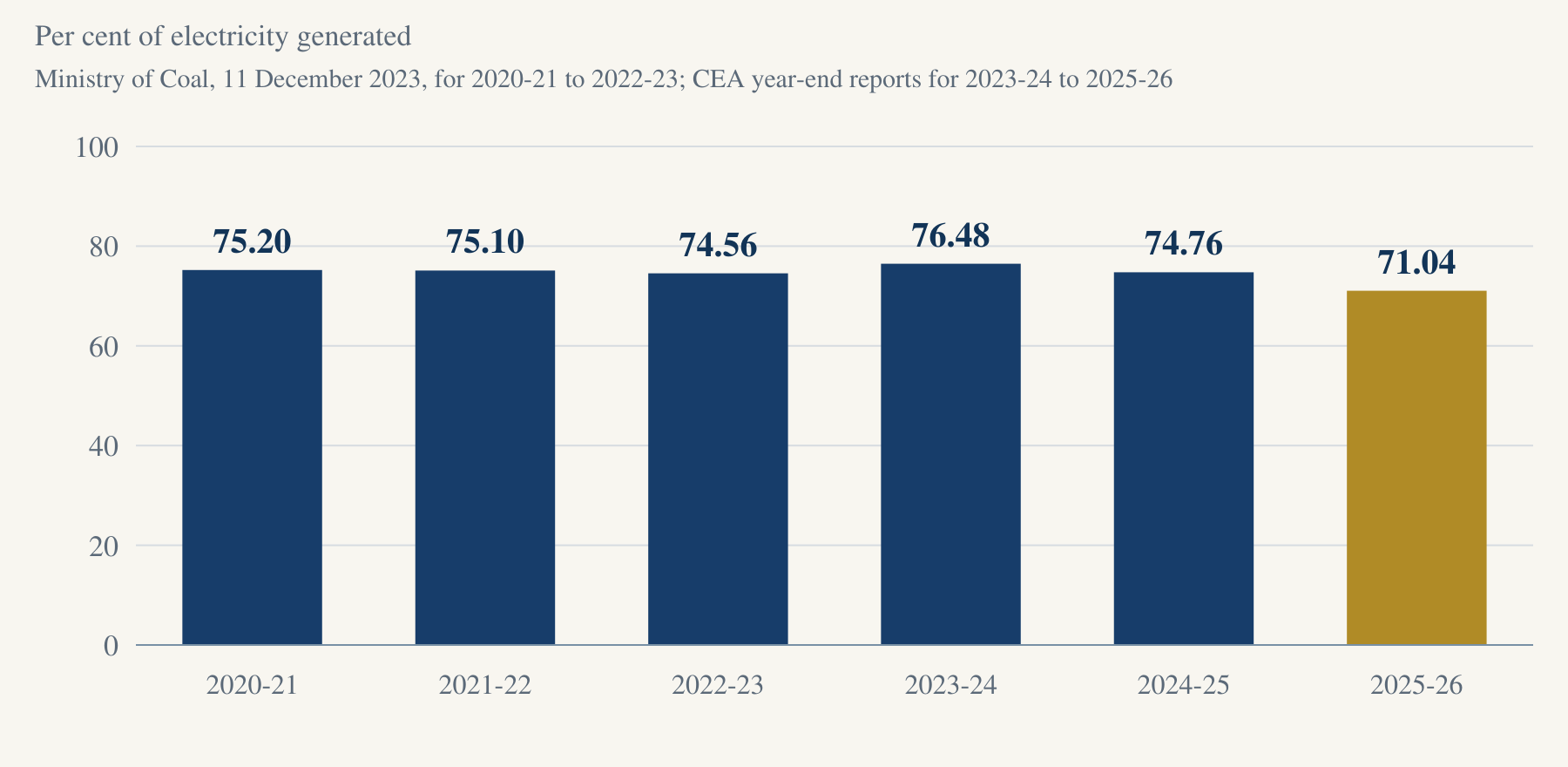
| Year | Electricity from fossil fuels | Electricity from non-fossil sources | Electricity from renewable energy, counting large hydro | Source |
|---|---|---|---|---|
| 2020-21 | 75.20 per cent | 24.80 per cent | not in the source used | RS Question 836, 11 December 2023 |
| 2021-22 | 75.10 per cent | 24.90 per cent | not in the source used | RS Question 836, 11 December 2023 |
| 2022-23 | 74.56 per cent | 25.44 per cent | not in the source used | RS Question 836, 11 December 2023 |
| 2023-24 | 76.48 per cent | 23.52 per cent | 20.75 per cent | CEA, RE Generation, March 2024 |
| 2024-25 | 74.76 per cent | 25.24 per cent | 22.13 per cent | CEA, RE Generation, March 2025 |
| 2025-26 | 71.04 per cent | 28.96 per cent | 25.97 per cent | CEA, RE Generation, March 2026 |
In 2021-22, which was the year of the Glasgow statement, non-fossil sources generated 24.90 per cent of India's electricity, as the Ministry of Coal's own table shows. The non-fossil share then rose by 4.06 percentage points in the four years to 2025-26.
Source: CEA, RE Generation, March 2026 ; CEA, RE Generation, March 2025 ; CEA, RE Generation, March 2024 ; RS Question 836, 11 December 2023 ; RS Question 301, 21 July 2026 .
More thermal power and more coal
Thermal power stations, which burn coal, lignite, gas and diesel, generated 1,114.71 billion units of electricity in 2021-22, by the Central Electricity Authority's Executive Summary. They generated 1,307.13 billion units in 2025-26, which is 192.42 billion units more, so the rise was 17.26 per cent in four years.
India's coal output rose faster than thermal power generation over the same four years, from 2021-22 to 2025-26. In 2021-22, India produced 778.210 million tonnes of raw coal, as the Coal Directory of India counts it. The Ministry of Coal told the Rajya Sabha on 20 July 2026 that production was 1,040.08 million tonnes in 2025-26, a rise of 33.65 per cent, against a target of 1,157 million tonnes for that year.
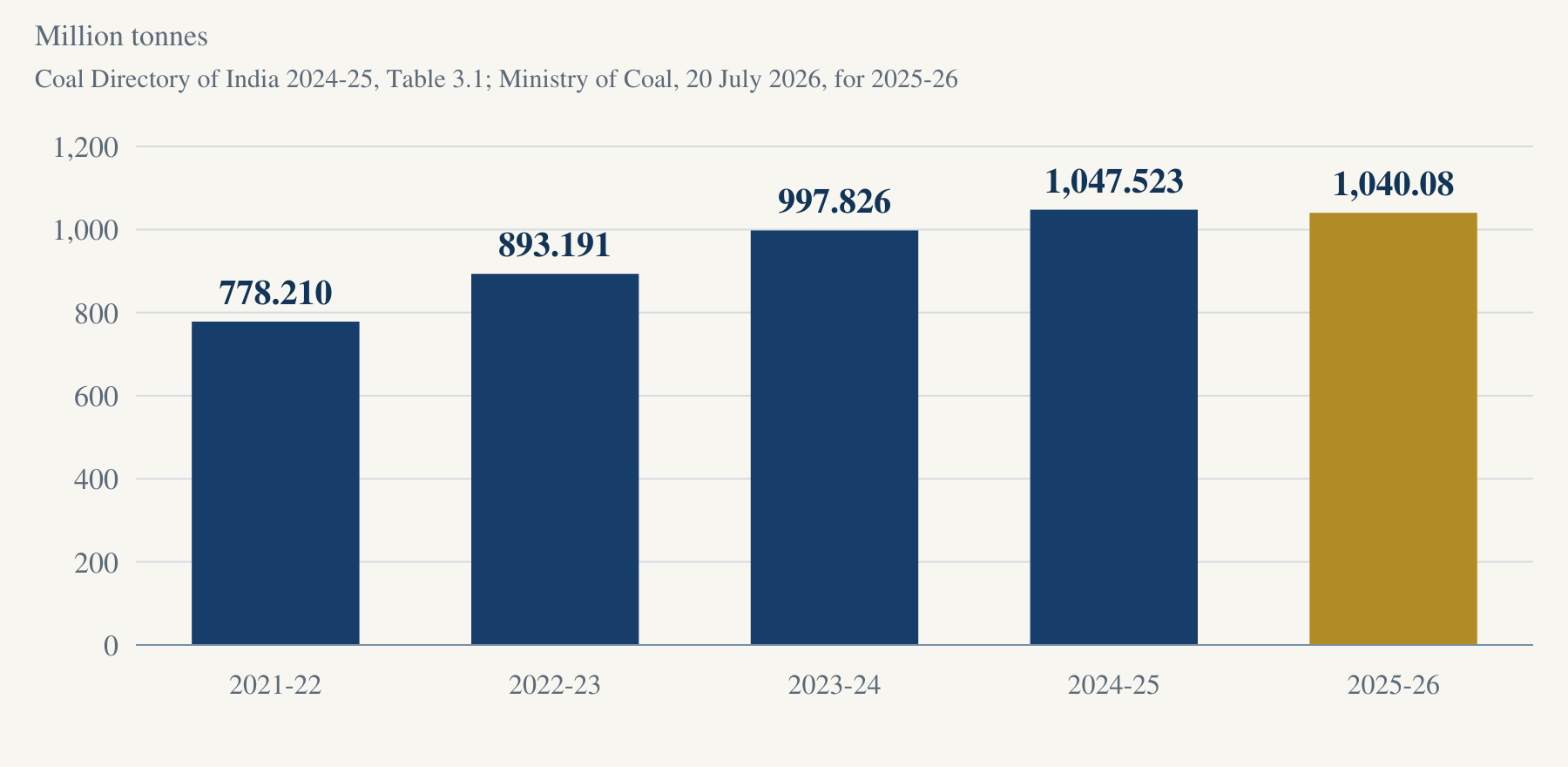
| What is measured | Figure | Source |
|---|---|---|
| Thermal power generated, 2021-22 | 1,114.71 billion units | CEA, Executive Summary, March 2023 |
| Thermal power generated, 2025-26 | 1,307.13 billion units | CEA, Executive Summary, March 2026 |
| Rise in thermal power generated, 2021-22 to 2025-26 | 17.26 per cent | This brief's arithmetic |
| Raw coal produced, 2021-22 | 778.210 million tonnes | Coal Directory 2024-25 |
| Coal produced, 2025-26 | 1,040.08 million tonnes | RS Question 47, 20 July 2026 |
| Rise in coal produced, 2021-22 to 2025-26 | 33.65 per cent | This brief's arithmetic |
Source: CEA, Executive Summary, March 2023 ; CEA, Executive Summary, March 2026 ; Coal Directory 2024-25 ; RS Question 47, 20 July 2026 .
More coal plants, and more being built
On 31 October 2021, the day before the Glasgow statement, India had 2,02,414.50 MW of coal-based power capacity, by the Central Electricity Authority's count. On 31 August 2026 it had 2,24,407.50 MW, which is 21,993 MW more.
The Authority's report on thermal projects, as on 31 July 2026, lists 42,700 MW of thermal capacity in its tentative programme of additions from 2026-27 to 2031-32. That count leaves out projects whose work is on hold and five stressed projects. The programme puts 16,620 MW in 2029-30, the financial year that ends in March 2030, which is more than in any other year of the programme.
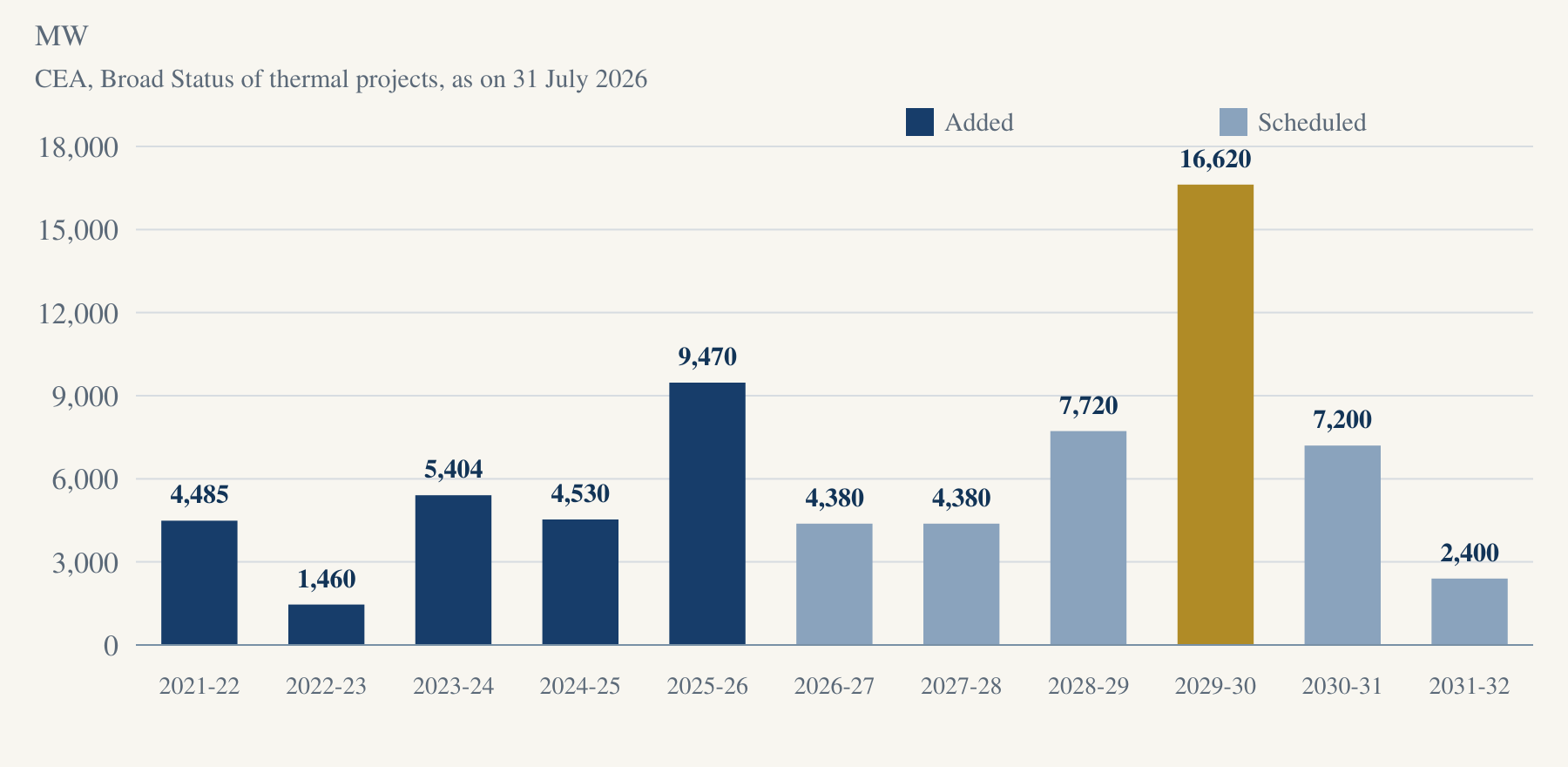
| What is counted | Figure | Source |
|---|---|---|
| Coal-based capacity installed, 31 October 2021 | 2,02,414.50 MW | CEA capacity, 31 October 2021 |
| Coal-based capacity installed, 31 August 2026 | 2,24,407.50 MW | CEA capacity, 31 August 2026 |
| Increase, 31 October 2021 to 31 August 2026 | 21,993 MW | This brief's arithmetic |
| Thermal capacity added, 2021-22 to 2025-26 | 25,349 MW | CEA thermal projects, July 2026 |
| Thermal capacity in the tentative programme to 2031-32, as on 31 July 2026, leaving out projects on hold and stressed projects | 42,700 MW | CEA thermal projects, July 2026 |
| Of which scheduled for 2029-30 | 16,620 MW | CEA thermal projects, July 2026 |
Source: CEA capacity, 31 October 2021 ; CEA capacity, 31 August 2026 ; CEA thermal projects, July 2026 .
The air: 55 cities over the national standard in 2025
On the Environment Ministry's own count, 55 cities under the National Clean Air Programme had more fine particles in their air in 2025 than the national standard allows over a year. These fine particles are known as PM2.5, and the standard for a year is 40 µg/m³, that is, micrograms in each cubic metre of air. On 13 August 2026 the Ministry gave the Rajya Sabha its count for each year: 42 cities in 2020, 58 in 2021, 62 in 2022, 66 in 2023, 61 in 2024 and 55 in 2025.
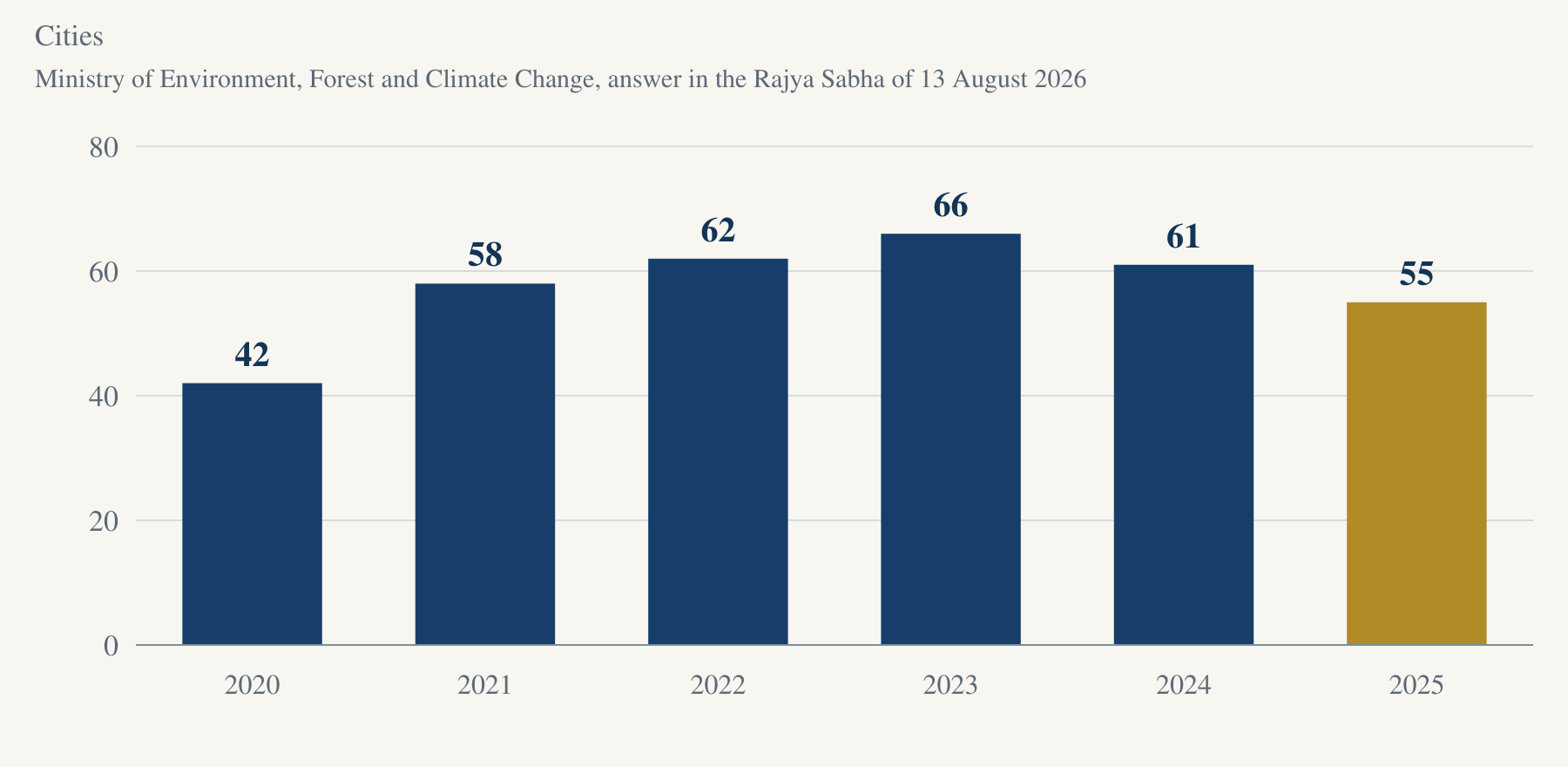
The same Ministry told the Rajya Sabha on 23 July 2026 that Delhi's PM2.5 level in 2025-26 was 102 µg/m³. That is 2.55 times the national standard, and 20.4 times the guideline of 5 µg/m³ that WHO sets for a year, as the Rajya Sabha's Standing Committee prints that guideline in its report of 12 December 2025.
Source: RS Question 2936, 13 August 2026 ; RS Question 545, 23 July 2026 ; Standing Committee report, 12 December 2025 .
Fossil fuels in the Government's own records on polluted air
The Government's own records, and Parliament's, name fossil fuels among the sources of polluted air, in the words below. On 30 July 2026 the Environment Ministry gave the Rajya Sabha the sources of Delhi's PM2.5 from a report of air quality experts of CAQM, which is the Commission for Air Quality Management in the National Capital Region. That report puts transport at 19 to 24 per cent of Delhi's PM2.5 in winter. It puts industry, which it says includes thermal power plants, at 8 to 10 per cent in winter and 9 to 15 per cent in summer.
The same report puts secondary particulate at 24 to 28 per cent of Delhi's PM2.5 in winter, and the Ministry's answer describes it as "transformed from gaseous emissions from Transport, Industries, Biomass burning, etc."
| Record | What it covers | What it names |
|---|---|---|
| 30 July 2026, Environment Ministry, from CAQM's experts | Delhi's PM2.5 in winter | Transport 19 to 24 per cent; industry, including thermal power plants, 8 to 10 per cent; secondary particulate 24 to 28 per cent |
| 19 March 2026, Environment Ministry | PM10 in the cities studied | Vehicular emissions 10 to 33 per cent, and industrial sources 8 to 34 per cent |
| 19 March 2026, Environment Ministry | PM10 in Mumbai and Pune | "Industrial Emission/Fossil fuel combustion" and "Fossil Fuel Combustion/Industrial Emission" |
| 2 June 2022, CAQM | Air in the National Capital Region | "polluting fuels like coal and Diesel oils" |
| 12 December 2025, the Rajya Sabha's Standing Committee | Delhi and the States around it | "the air pollution caused due to thermal power plants" |
Each row gives one Government record and what it names as a source of polluted air, in its own words or figures.
On 19 March 2026 the same Ministry listed the dominant sources of PM10, which counts somewhat larger particles, that studies in major cities had found. For Mumbai its list names "Industrial Emission/Fossil fuel combustion", and for Pune it names "Fossil Fuel Combustion/Industrial Emission". For Chennai it names "Industries including Power plants".
CAQM's Direction No. 64 of 2 June 2022 opens by reciting that "emissions from industries using polluting fuels like coal and Diesel oils etc. have adverse impact on air quality in the National Capital Region and Adjoining Areas". The Rajya Sabha's Standing Committee on the environment wrote in its report of 12 December 2025: "While stubble burning gets all the limelight in public and media, the air pollution caused due to thermal power plants located in the adjoining States often miss the scrutiny it deserves."
Source: RS Question 1344, 30 July 2026 ; RS Question 3107, 19 March 2026 ; CAQM Direction, 2 June 2022 ; Standing Committee report, 12 December 2025 .
The sulphur dioxide limits for coal plants, 2015 to 2025
By a notification dated 7 December 2015, the Environment Ministry set limits on sulphur dioxide from coal and lignite power plants. The equipment that removes sulphur dioxide from a plant's chimney gas is called flue gas desulphurisation, or FGD. The Ministry told the Rajya Sabha on 31 March 2022 that the limits "were to be implemented within two years from the notification i.e. 07.12.2017". After that date, the deadline for the plants nearest the big cities kept moving, as the table shows.
| Notification | Deadline for the plants nearest the big cities | Source |
|---|---|---|
| 7 December 2015 | Limits set, to be implemented within two years, which the Ministry's answer of 31 March 2022 dates 07.12.2017 | RS Question 3238, 31 March 2022 |
| 31 March 2021 | 31 December 2022 | Gazette, 31 March 2021 |
| 5 September 2022 | 31 December 2024, for sulphur dioxide | Gazette, 5 September 2022 |
| 30 December 2024 | 31 December 2027, for sulphur dioxide | Gazette, 30 December 2024 |
| 11 July 2025 | 31 December 2027 kept; the sulphur dioxide limits no longer apply to Category C plants that meet the stack height criteria | Gazette, 11 July 2025 |
Each row is one notification and the date it set for the plants within ten kilometres of the National Capital Region or any city of million-plus population, which the notifications call Category A. The dates apply to the plants that stay in service.
The notification of 11 July 2025 then provides that "the Sulphur dioxide emission standards shall not be applicable to all Category C thermal power plants subject to ensuring compliance of stack height criteria", which are rules on the height of a plant's chimney. Category C covers every plant outside ten kilometres of the National Capital Region, any city of million-plus population, a critically polluted area and a city that CPCB lists as not attaining the national air standards. In the Ministry of Power's table of 11 August 2025, Category C held 1,66,885.5 MW of the 2,11,519.5 MW of coal and lignite capacity it had sorted into categories. By this brief's arithmetic, that is 78.9 per cent.
The same answer of 11 August 2025 counted 57 units with an FGD installed, out of the 600 units in its table. The Standing Committee noted with concern, in its report of 12 December 2025, that some thermal power plants near the National Capital Region that must meet the sulphur dioxide limits lack controls such as FGDs "considering their significant role in contributing to" the region's air pollution. It added: "The Committee is of the view that repeated extensions may not be given to these thermal power plants for meeting their compliance norms."
Source: Gazette, 7 December 2015 ; RS Question 3238, 31 March 2022 ; Gazette, 31 March 2021 ; Gazette, 5 September 2022 ; Gazette, 30 December 2024 ; Gazette, 11 July 2025 ; RS Question 2552, 11 August 2025 ; Standing Committee report, 12 December 2025 .
What the updated NDC kept
The Government's own words on coal point the same way. On 21 December 2021 it told the Rajya Sabha: "The Government of India has made no commitment to phasing out coal by 2030." On 27 March 2023 the Minister of Coal told the Rajya Sabha that "coal is going to stay as a major source of energy in the foreseeable future". On 24 September 2025 the Minister of Coal and Mines said that coal demand is "projected to reach 1.6 billion tonnes by 2030".
On 21 December 2021, the Ministry of New and Renewable Energy gave the Rajya Sabha a broad roadmap to 2030. The roadmap listed "Achieve 500 GW cumulative installed electricity capacity from non-fossil fuel sources by 2030", and it also listed "Reduce the carbon emission projected from 2021 to 2030 by one billion tonnes".
On 3 August 2022 the Cabinet approved India's updated Nationally Determined Contribution, the commitment that India makes to the United Nations under the Paris Agreement. Its release says that the update "translates the ‘Panchamrit’ announced at COP 26 into enhanced climate targets". The release then states the commitment in these words: "As per the updated NDC, India now stands committed to reduce Emissions Intensity of its GDP by 45 percent by 2030, from 2005 level and achieve about 50 percent cumulative electric power installed capacity from non-fossil fuel-based energy resources by 2030."
Neither 500 GW nor the cut of one billion tonnes is in that commitment, and it sets no target for energy: its target of about 50 percent counts installed capacity, which is the size of power plants and not the power they produce.
A Member then asked a question in the Rajya Sabha that was titled "Omission of two Panchamrit promises". The Ministry of Environment, Forest and Climate Change answered on 22 December 2022 that the five elements "have been appropriately incorporated" in the updated NDC. The targets that its answer then listed did not include 500 GW or the cut of one billion tonnes, and it stated the capacity target as one to be met "with the help of transfer of technology and low-cost international finance including from Green Climate Fund".
On 13 August 2026 the same Ministry told the Rajya Sabha that the NDC "comprises of three quantitative targets", which it named as emissions intensity, the non-fossil share of installed electric power capacity and an additional carbon sink.
Five years after Glasgow, India mines more coal, has more coal-fired capacity and generates more power from fossil fuels than it did in 2021-22, and fossil fuels still supplied 87 per cent of its primary energy in 2025, on NITI Aayog's own estimate.
Source: RS Question 2688, 21 December 2021 ; PIB 240906, 27 March 2023 ; PIB 276493, 24 September 2025 ; PIB 236437, 3 August 2022 ; RS Question 1816, 22 December 2022 ; RS Question 2928, 13 August 2026 .
Terms, explained
- Panchamrit
- Panchamrit means five nectar elements. The Prime Minister used the word for the five climate targets he announced at COP26 in Glasgow on 1 November 2021.
- Nationally Determined Contribution
- A Nationally Determined Contribution, or NDC, is the climate commitment that a country sends to the United Nations under the Paris Agreement. The Cabinet approved India's updated NDC on 3 August 2022.
- Primary energy
- Primary energy counts the coal, oil, gas, biomass, nuclear fuel, water, wind and sunlight that a country draws on before any of it is converted into electricity or refined fuel.
- Fossil fuels and non-fossil sources
- Fossil fuels are coal, lignite, oil and gas. In the electricity figures, non-fossil sources are nuclear power, large hydro and other renewable energy.
- Renewable energy, counting large hydro
- The Central Electricity Authority's tables count large hydro stations as renewable energy, together with solar, wind, small hydro, biomass and others.
- Installed capacity
- Installed capacity is the size of power plants, counted in megawatts (MW). It says how much power the plants could produce, not how much they did produce.
- PM2.5 and PM10
- PM2.5 counts the finest particles in the air and PM10 counts somewhat larger ones, by their weight in each cubic metre of air.
- National standard and WHO guideline
- The national standard is the limit that India sets for the air, and WHO's guideline is the level the World Health Organization recommends. They are different limits, and neither is the Air Quality Index.
- FGD
- Flue gas desulphurisation, or FGD, is the equipment that removes sulphur dioxide from a power plant's chimney gas.
- Billion units
- A billion units is a billion kilowatt-hours of electricity, the measure in which the Central Electricity Authority counts power generated.
Downloads for readers and the press
Sources & method
Every figure in this brief comes from a document that the Government, one of its bodies or NITI Aayog published, and each is printed with its date and its source on the same page.
The shares of electricity for 2023-24 to 2025-26 come from the Central Electricity Authority's year-end tables, while those for 2020-21 to 2022-23 come from the Ministry of Coal's answer to Rajya Sabha Question 836, given on 11 December 2023. Both sources count coal, lignite, gas and diesel as fossil fuels. This brief works out each year's fossil share as whatever remains after the non-fossil share that the source prints.
The rises in thermal power and in coal output are this brief's arithmetic on the figures that the Central Electricity Authority, the Coal Controller and the Ministry of Coal printed. The increase in coal-based capacity is the difference between two of the Authority's installed-capacity reports, so it is net of any plant retired in between.
NITI Aayog marks its primary energy supply for 2025 as estimated, and this brief treats the shares for 2025 as part of that estimate. Those shares are on different bases, so this brief quotes each one in NITI Aayog's own words and never adds them together. The figures for electricity measure only the part of energy that is electricity.
Each quotation in this brief was found again, word for word, in the saved copy of its source when the brief was built. The office keeps a copy of every source it read, and each one is linked here to its public address.
The counts of cities over the PM2.5 standard, Delhi's PM2.5 and the sources of polluted air are the Environment Ministry's own answers in the Rajya Sabha. The ratio of Delhi's level to the national standard and to WHO's guideline, the change in the count of cities and Category C's share of capacity are this brief's arithmetic.
- PIB 226227, 1 November 2021 .
- PIB 236437, 3 August 2022 .
- RS Question 2688, 21 December 2021 .
- RS Question 1816, 22 December 2022 .
- NITI Aayog, February 2026 .
- CEA, RE Generation, March 2026 .
- CEA, RE Generation, March 2025 .
- CEA, RE Generation, March 2024 .
- RS Question 836, 11 December 2023 .
- RS Question 301, 21 July 2026 .
- CEA, Executive Summary, March 2023 .
- CEA, Executive Summary, March 2026 .
- Coal Directory 2024-25 .
- RS Question 47, 20 July 2026 .
- PIB 240906, 27 March 2023 .
- PIB 276493, 24 September 2025 .
- CEA capacity, 31 October 2021 .
- CEA capacity, 31 August 2026 .
- CEA thermal projects, July 2026 .
- RS Question 2928, 13 August 2026 .
- RS Question 2936, 13 August 2026 .
- RS Question 545, 23 July 2026 .
- RS Question 1344, 30 July 2026 .
- RS Question 3107, 19 March 2026 .
- CAQM Direction, 2 June 2022 .
- Standing Committee report, 12 December 2025 .
- Gazette, 7 December 2015 .
- Gazette, 31 March 2021 .
- Gazette, 5 September 2022 .
- Gazette, 30 December 2024 .
- Gazette, 11 July 2025 .
- RS Question 3238, 31 March 2022 .
- RS Question 2552, 11 August 2025 .