The rate rise
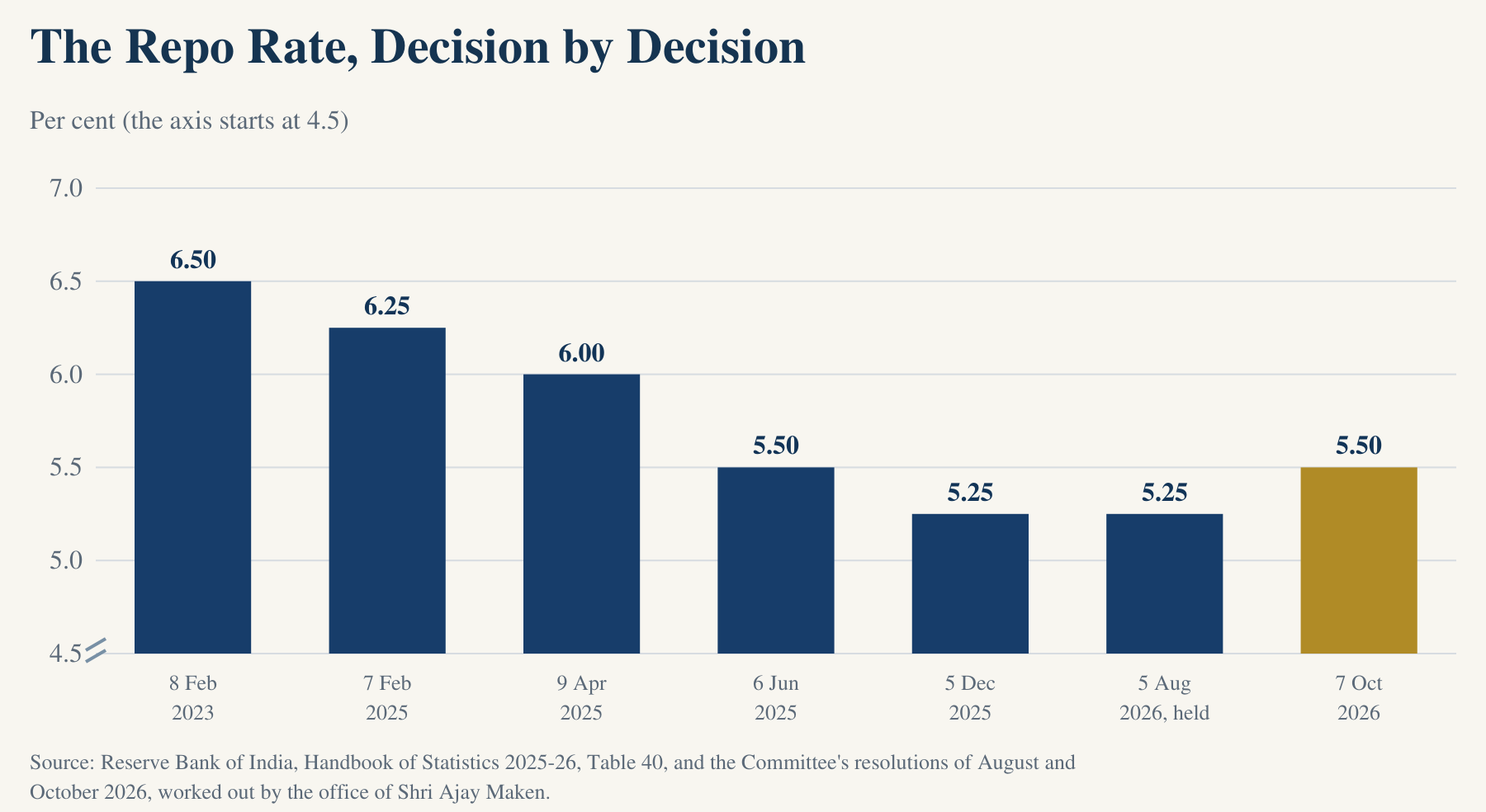
The Committee cut the repo rate four times in 2025, when it went from 6.50 per cent to 5.25 per cent, which was a total of 125 basis points. It held the rate at 5.25 per cent in August 2026, but it raised the rate to 5.50 per cent when it announced its decision on 7 October 2026.
The Committee also changed its stance to calibrated tightening. Paragraph 18 of the minutes explains the change in these words: "It only signals that given the current conditions, rate cuts are off the table in the near term and policy action ahead can only be a rate hike or a pause, depending on the evolving conditions and the outlook."
Two members, Dr. Nagesh Kumar and Prof. Ram Singh, wanted the stance kept at neutral, and both of them voted for the rise. Dr. Kumar wrote in paragraph 26: "In view of the continued geopolitical and trade policy uncertainties, I feel that a neutral stance remains appropriate." Prof. Singh wrote in paragraph 39: "I do not favour shifting the stance from neutral to tightening mode, as it may signal an extended cycle of rate hikes."
Source: RBI Handbook of Statistics 2025-26, Table 40 ; RBI, MPC resolution of 7 October 2026 ; RBI, MPC minutes of October 5 to 7, 2026 .
The essentials
The Monetary Policy Committee met from 5 to 7 October 2026 and raised the repo rate. This brief sets out what the minutes of that meeting record about food prices, the monsoon and the rate rise, and reads them against the official figures and the Committee's own record.
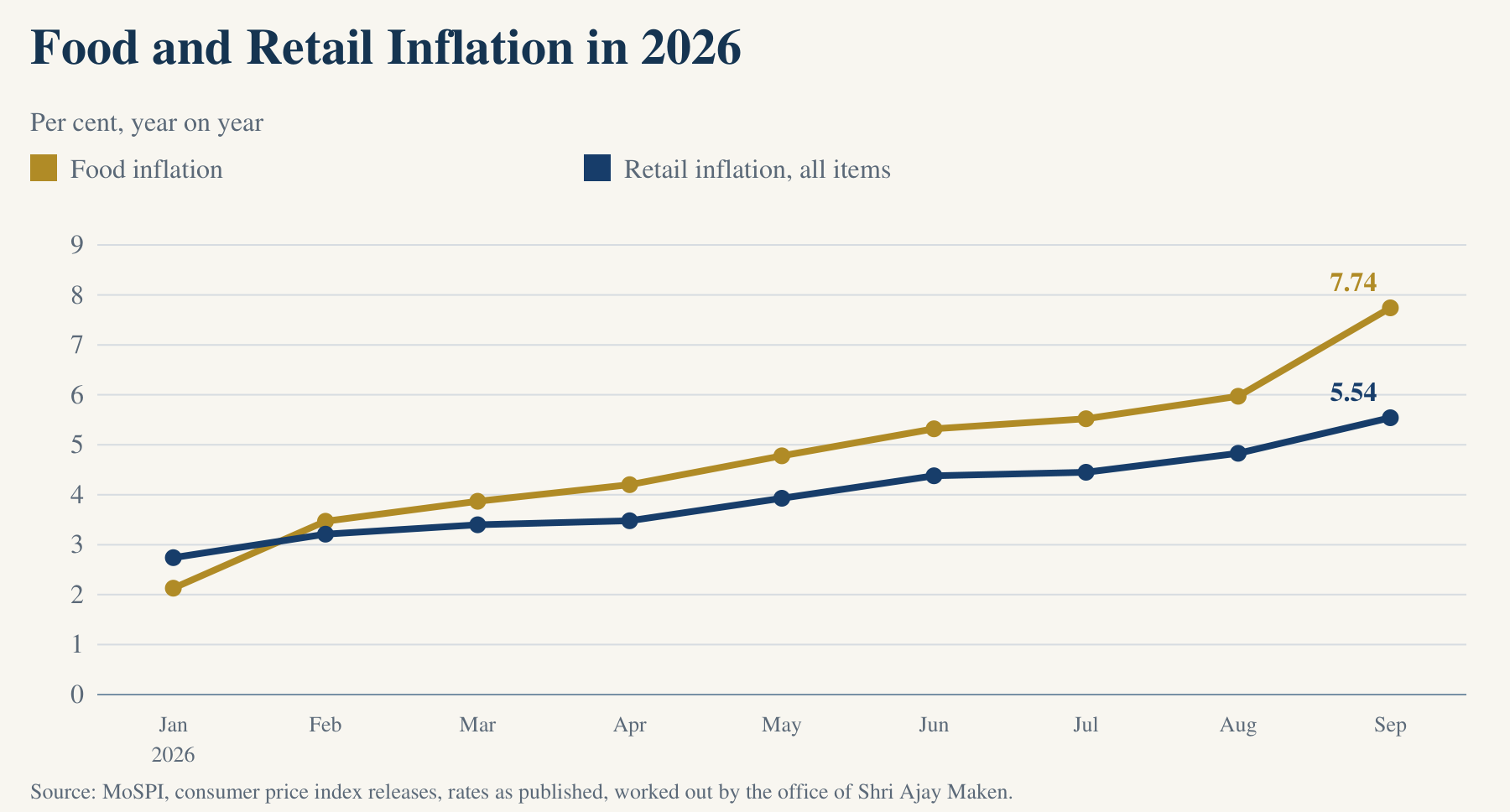
Food inflation reached 7.74 per cent in September 2026, the highest in 21 months, since December 2024. The Ministry of Statistics published that figure on 12 October 2026. Five days earlier, on 7 October, the Reserve Bank's Monetary Policy Committee had raised the repo rate by 25 basis points. All six members voted for the rise, which took the rate to 5.50 per cent. The Reserve Bank published their minutes on 21 October 2026. They show that five of the six members, in their own statements in the minutes, named food prices, the monsoon or the weather. Retail inflation rose in every month from February to September 2026. It went from 2.74 per cent in January to 5.54 per cent in September, which was the highest in 23 months.
Source: MoSPI, CPI release of 12 October 2026 ; RBI, MPC minutes of October 5 to 7, 2026 ; RBI, MPC resolution of 7 October 2026 .
The vote
All six members voted to raise the repo rate by 25 basis points, which took it to 5.50 per cent. The Committee also changed its stance to calibrated tightening. Two members, Dr. Nagesh Kumar and Prof. Ram Singh, wanted the stance kept at neutral.
Source: RBI, MPC minutes of October 5 to 7, 2026 .
Food and the monsoon in the minutes
In their own statements in the minutes, five of the six members named food prices, the monsoon or the weather. The resolution names the deficient monsoon and El Niño among the sources of continued pressure on inflation.
Source: RBI, MPC minutes of October 5 to 7, 2026 .
Food and retail inflation
Food inflation was 2.13 per cent in January 2026 and 7.74 per cent in September 2026. Retail inflation on all items rose in each month from February until it reached 5.54 per cent in September.
Source: MoSPI, CPI release of 12 October 2026 ; RBI DBIE, consumer price index .
What comes next
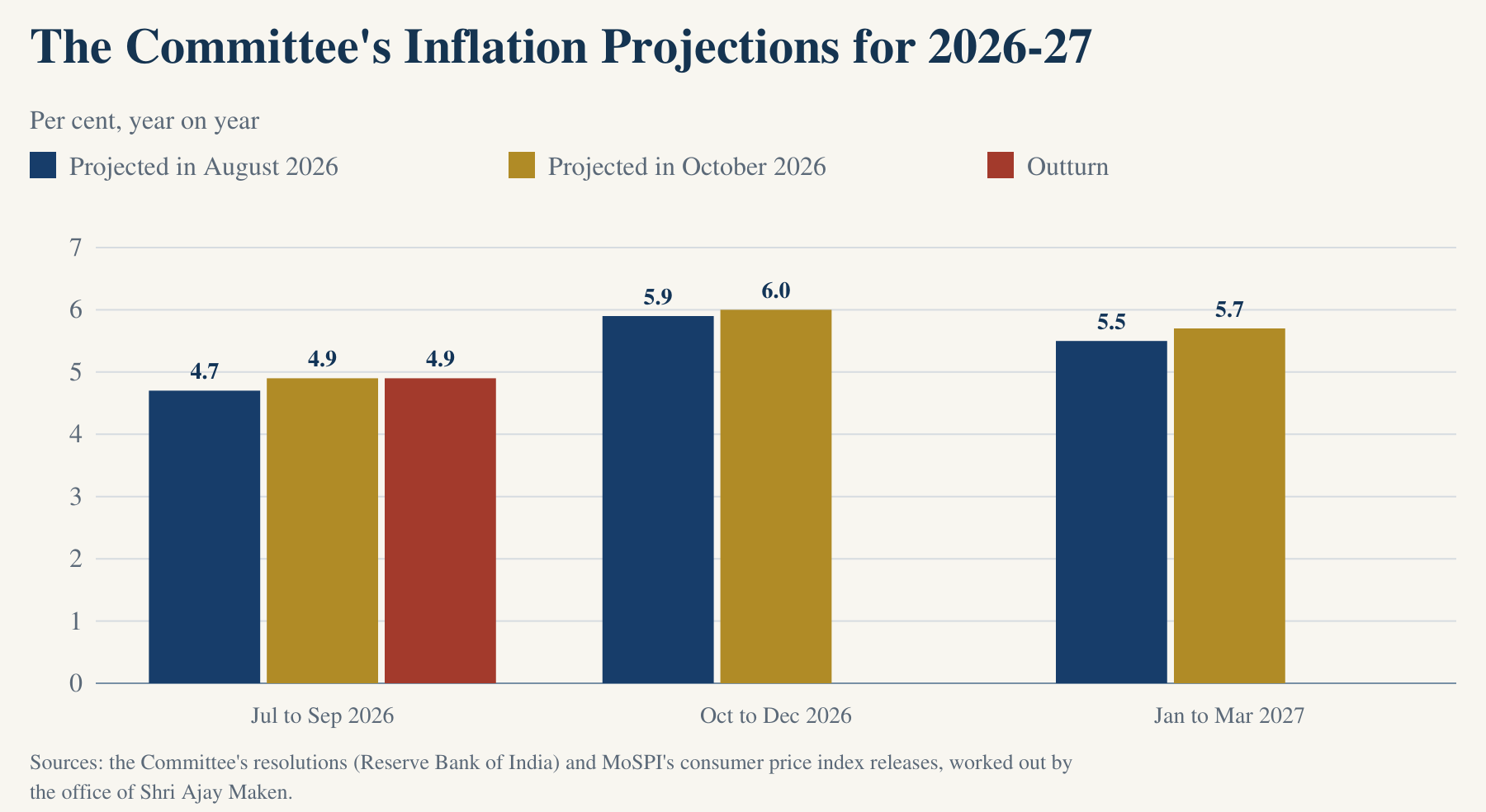
The Committee projects retail inflation of 6.0 per cent for October to December 2026, and paragraph 18 of its minutes says that the new stance signals that rate cuts are off the table in the near term.
Source: RBI, MPC minutes of October 5 to 7, 2026 ; RBI, MPC resolution of 7 October 2026 .
The monsoon
On 29 May 2026, the India Meteorological Department forecast that the season's rainfall was likely to be 90 per cent of its long period average, with a model error of plus or minus 4 per cent. It put the chance that rainfall would be below normal or less at 84 per cent. The season ended 13 per cent below that average, as footnote 16 of the Governor's policy statement of 7 October 2026 records.
Source: IMD, monsoon forecast of 29 May 2026 ; RBI, the Governor's policy statement of 7 October 2026 .
Food and Retail Inflation in 2026
Food inflation was 2.13 per cent in January 2026 and 7.74 per cent in September 2026. Retail inflation on all items rose in each month from February until it reached 5.54 per cent in September.
Source: MoSPI, CPI release of 12 October 2026 ; RBI DBIE, consumer price index .
View the figures in a table
| Point | Per cent | Source |
|---|---|---|
| January 2026 | 2.13 | RBI DBIE copy of MoSPI's CPI |
| February 2026 | 3.47 | RBI DBIE copy of MoSPI's CPI |
| March 2026 | 3.87 | RBI DBIE copy of MoSPI's CPI |
| April 2026 | 4.20 | RBI DBIE copy of MoSPI's CPI |
| May 2026 | 4.78 | RBI DBIE copy of MoSPI's CPI |
| June 2026 | 5.32 | RBI DBIE copy of MoSPI's CPI |
| July 2026 | 5.52 | RBI DBIE copy of MoSPI's CPI |
| August 2026 | 5.97 | RBI DBIE copy of MoSPI's CPI |
| September 2026 | 7.74 | MoSPI, CPI, September 2026 release |
The Repo Rate, Decision by Decision
The Committee cut the repo rate four times in 2025, when it went from 6.50 per cent to 5.25 per cent, which was a total of 125 basis points. It held the rate at 5.25 per cent in August 2026, but it raised the rate to 5.50 per cent when it announced its decision on 7 October 2026.
Source: RBI Handbook of Statistics 2025-26, Table 40 ; RBI, MPC resolution of 5 August 2026 ; RBI, MPC resolution of 7 October 2026 .
View the figures in a table
| Point | Per cent | Source |
|---|---|---|
| 8 Feb 2023 | 6.50 | Handbook of Statistics 2025-26, Table 40 |
| 7 Feb 2025 | 6.25 | Handbook of Statistics 2025-26, Table 40 |
| 9 Apr 2025 | 6.00 | Handbook of Statistics 2025-26, Table 40 |
| 6 Jun 2025 | 5.50 | Handbook of Statistics 2025-26, Table 40 |
| 5 Dec 2025 | 5.25 | Handbook of Statistics 2025-26, Table 40 |
| 5 Aug 2026 | 5.25 | RBI, Resolution of the Monetary Policy Committee, August 3 to 5, 2026 |
| 7 Oct 2026 | 5.50 | RBI, Resolution of the Monetary Policy Committee, October 5 to 7, 2026 |
The Committee's Inflation Projections for 2026-27
On 29 May 2026, the India Meteorological Department forecast that the season's rainfall was likely to be 90 per cent of its long period average, with a model error of plus or minus 4 per cent. It put the chance that rainfall would be below normal or less at 84 per cent. The season ended 13 per cent below that average, as footnote 16 of the Governor's policy statement of 7 October 2026 records.
Source: RBI, MPC resolution of 5 August 2026 ; RBI, MPC resolution of 7 October 2026 ; MoSPI, CPI release of 12 October 2026 .
View the figures in a table
| Point | Per cent | Source |
|---|---|---|
| Jul to Sep 2026, projected in August 2026 | 4.7 | RBI, Resolution of the Monetary Policy Committee, August 3 to 5, 2026 |
| Jul to Sep 2026, projected in October 2026 | 4.9 | RBI, Resolution of the Monetary Policy Committee, October 5 to 7, 2026 |
| Jul to Sep 2026, outturn | 4.9 | MoSPI, press release of 12 October 2026, CPI for September 2026 (PIB 2322244) |
| Oct to Dec 2026, projected in August 2026 | 5.9 | RBI, Resolution of the Monetary Policy Committee, August 3 to 5, 2026 |
| Oct to Dec 2026, projected in October 2026 | 6.0 | RBI, Resolution of the Monetary Policy Committee, October 5 to 7, 2026 |
| Jan to Mar 2027, projected in August 2026 | 5.5 | RBI, Resolution of the Monetary Policy Committee, August 3 to 5, 2026 |
| Jan to Mar 2027, projected in October 2026 | 5.7 | RBI, Resolution of the Monetary Policy Committee, October 5 to 7, 2026 |
What the Committee Had Before It, and the Same Months on One Base
When the Committee met, the latest published rate of retail inflation was August's. The resolution in the minutes gives it as 4.8 per cent, up from 4.5 per cent in July. The Ministry published September's figures on 12 October 2026, after the meeting, and they showed food inflation at 7.74 per cent and retail inflation at 5.54 per cent.
| August 2026, per cent | Published 14 September 2026, before the meeting | Final, published 12 October 2026 |
|---|---|---|
| Retail inflation | 4.82 | 4.83 |
| Food inflation (Consumer Food Price Index) | 5.95 | 5.97 |
The table gives August's final figures, which the Ministry published on 12 October 2026. The August figures before the Committee were those of 14 September 2026: 4.82 per cent for retail inflation and 5.95 per cent for food inflation. Food inflation here is the Ministry's Consumer Food Price Index for India as a whole. September's figures are provisional, as the Ministry marks them.
On the Ministry's 2024 base, the all-items consumer price index rose by 4.8 per cent between January and September 2026, from 104.45 to 109.49. Over the same nine months of 2025, on the same base, it rose by 2.0 per cent, from 101.67 to 103.74.
| Year | January index | September index | Rise, per cent |
|---|---|---|---|
| 2025 | 101.67 | 103.74 | 2.0 |
| 2026 | 104.45 | 109.49 | 4.8 |
Both rows are on the Ministry's 2024 base and cover the same months, January to September, so the difference between them is not a change of base or of season. The index is the all-items consumer price index for India as a whole, from Annexure IV of the release of 12 October 2026.
Source: MoSPI, CPI release of 14 September 2026 ; MoSPI, CPI release of 12 October 2026 ; RBI, MPC minutes of October 5 to 7, 2026 .
What the members wrote on food prices and the monsoon
The minutes of 5 to 7 October 2026 carry the statement that each member wrote. Five of the six members wrote at least one sentence on food prices, the monsoon or the weather in their own statements. The Governor's statement in the minutes, paragraphs 51 to 56, has no such sentence. It speaks of the second round effects of the supply shock. Where a sentence carries a dash, it is cut there with three dots, and the whole sentence is in the minutes.
| Member | Paragraph | The member's words |
|---|---|---|
| Dr. Nagesh Kumar | 25 | The inflationary outlook, on the other hand, remains challenging due to a combination of factors, including the deficient monsoon, rising crude oil prices, precious metals prices remaining at elevated levels, and exchange rate depreciation, leading to a revision of the forecast for headline inflation for 2026-27 by 20 basis points from 5.0% at the last policy to 5.2% and core inflation by 10 basis points to 4.4%. |
| Shri Saugata Bhattacharya | 27 | El Niño led weather disruptions have resulted in an increase in prices of many agricultural commodities, particularly of edible oils, sugar and, to an extent, cereals. |
| Prof. Ram Singh | 39 | Current inflation is primarily due to supply-side factors, rising fuel, food, and commodity prices, and their effects. |
| Prof. Ram Singh | 40 | Coming on the heels of stress on the farm sector due to below-normal rains and El Niño, rising input costs and global uncertainty, significant rate hikes would hurt profit margins and the sustainability of capex plans of large and small firms. |
| Shri Indranil Bhattacharyya | 43 | Inflation is clearly on the rise, averaging about 5.8 per cent in the immediate three quarters, driven by food and fuel prices. |
| Shri Indranil Bhattacharyya | 44 | Therefore, the inflation outlook merits greater attention, given supply side pressures from crude and food prices are unlikely to relent quickly. |
| Dr. Poonam Gupta | 49 | Domestically, weather-related adversities and global oil and commodity prices may continue to put upward pressure on headline inflation. |
The resolution in the minutes names the monsoon in paragraph 13, in these words: "The near-term outlook on inflation points towards continued pressures from supply side on account of the deficient monsoon, ongoing El Niño conditions and high energy and other commodity prices, the pass through of which is still continuing." In paragraph 12 it says: "Food price increases have become more broad based along with notable spikes in certain items such as sugar and onion."
Source: RBI, MPC minutes of October 5 to 7, 2026 .
What the members wrote on the outlook
The members also wrote about where inflation is going and what the Committee may do next. The Committee projects retail inflation of 6.0 per cent for October to December 2026, and these are the members' own sentences on that outlook, each with its paragraph.
| Member | Paragraph | The member's words |
|---|---|---|
| Shri Saugata Bhattacharya | 29 | Data increasingly suggests that price pressures are getting entrenched into the economic system. |
| Shri Saugata Bhattacharya | 29 | Input prices, recorded in Wholesale Price Indices, have been printing close to 9% yoy. |
| Shri Saugata Bhattacharya | 32 | In this context, might the broad monetary policy environment in India now be too accommodative? Inflation risks and financial markets suggest it is. |
| Prof. Ram Singh | 36 | Furthermore, the RBI’s September household survey showed the 3-month median inflation expectation jumped to 9.9%, reflecting households' anticipation of a higher cost of living. |
| Prof. Ram Singh | 37 | Headline CPI inflation is expected to remain elevated, averaging almost 5.8 per cent over the next three quarters, nudging the upper limit of the FIT tolerance band. |
| Prof. Ram Singh | 37 | Additionally, at the current repo rate level, the projected inflation trajectory will render the real rate negative, generating perverse saving-consumption trade-offs. |
| Prof. Ram Singh | 38 | For now, there is a case for incremental, mild repo rate hikes, not high-for-long rates. |
| Shri Indranil Bhattacharyya | 44 | Given the present global and domestic circumstances, rate cuts are not an option in the near term. |
| Dr. Poonam Gupta | 47 | Yet, with projections indicating the likelihood of headline inflation hitting the upper tolerance limit of 6 per cent, one may not want to wait for more definitive evidence of generalisation, and instead be mindful of the fact that monetary policy works with a lag. |
| Dr. Poonam Gupta | 49 | Under these circumstances, it is conceivable that a further increase in the policy rate might be needed to keep inflation low and inflationary expectations anchored. |
| Shri Sanjay Malhotra | 52 | Headline CPI is projected to touch the upper tolerance band in Q3 and remain significantly above 5 per cent in the next two quarters. |
| Shri Sanjay Malhotra | 53 | In terms of the diffusion index, there are increasing signs of generalisation of inflation as 37 per cent of the commodities in the CPI basket had inflation above 4 per cent in August ... it was merely 20 per cent in March. |
Source: RBI, MPC minutes of October 5 to 7, 2026 .
Four questions, and what the minutes answer
The Reserve Bank published the minutes on 21 October 2026, which is the fourteenth day after the meeting, as Section 45ZL of the Reserve Bank of India Act, 1934 requires. They carry the resolution, each member's vote and each member's statement.
| The question | What the minutes answer |
|---|---|
| What each member wrote on food prices and the monsoon | In their own statements in the minutes, five of the six members wrote at least one such sentence. The Governor's statement in the minutes, paragraphs 51 to 56, has none. The resolution names the deficient monsoon and El Niño. |
| Why two members wanted the stance kept at neutral | Dr. Nagesh Kumar cites "the continued geopolitical and trade policy uncertainties". Prof. Ram Singh writes that a change of stance "may signal an extended cycle of rate hikes". |
| Whether any member's statement in the minutes gives the season's shortfall of 13 per cent below the long period average | No member's statement in the minutes gives that figure, and neither does the resolution. Dr. Nagesh Kumar writes of "the deficient monsoon", and Prof. Ram Singh of "below-normal rains". |
| What the members expect for October to December 2026 | The Committee projects 6.0 per cent. The Governor writes in the minutes that headline CPI is "projected to touch the upper tolerance band in Q3", and Dr. Poonam Gupta writes of "the likelihood of headline inflation hitting the upper tolerance limit of 6 per cent". |
On what monetary policy can do about inflation that comes from the supply side, the resolution of 7 October 2026 says: "As regards supply side inflation, monetary policy primarily acts by curtailing second round effects (inflation expectations and firm level pricing behaviour, etc.), which take time to manifest and are difficult to extract from available data."
Footnote 13 of the Governor's policy statement of 7 October 2026 records that onion prices rose by about 85 per cent between the end of June and the end of September 2026.
Source: RBI, MPC minutes of October 5 to 7, 2026 ; RBI, MPC resolution of 7 October 2026 ; RBI, the Governor's policy statement of 7 October 2026 .
Food inflation rose in every month from February to September 2026, and the monsoon ended 13 per cent below its average. Paragraph 18 of the minutes says that the new stance signals that rate cuts are off the table in the near term, and that the next action can only be a rise or a pause.
Terms, explained
- Monetary Policy Committee
- The six-member committee, constituted under Section 45ZB of the Reserve Bank of India Act, 1934, that fixes the policy repo rate. The minutes of October 2026 list its members as the Governor, who chairs it, a Deputy Governor, an Executive Director of the Reserve Bank, and three members from outside the Bank.
- Repo rate
- The policy rate that the Committee fixes. The resolution of 7 October 2026 records that the standing deposit facility rate, the marginal standing facility rate and the Bank Rate moved with it.
- Basis point
- One hundredth of a percentage point, so 25 basis points is a quarter of a percentage point.
- Stance
- The Committee's statement of which way the repo rate may move next. Calibrated tightening, in the Committee's own words, means that the next step can only be a rise or a pause.
- Food inflation
- The rise in food prices over the same month a year earlier, on the Ministry of Statistics' consumer price index for India as a whole.
- Long period average
- The average rainfall of the June to September season over 1971 to 2020, which the India Meteorological Department puts at 87 centimetres for the country as a whole.
- Minutes
- The record the Reserve Bank must publish on the fourteenth day after each meeting, under Section 45ZL of the Reserve Bank of India Act, 1934, with each member's vote and each member's statement.
Downloads for readers and the press
Sources & method
Every quotation in this brief is copied from the Reserve Bank's own minutes, resolutions and statements as published on its website, and each was found again, word for word, in the saved copy when this brief was built.
A member is counted as writing on food prices or a food item, or on the monsoon or the weather, when a sentence of the member's statement in the minutes names one of these words. For food, the words are food and words beginning with it, vegetables, pulses, cereals, onions, tomatoes, potatoes, edible oils, sugar, spices, eggs, meat, milk, poultry, protein items and perishables. For the monsoon or the weather, they are the monsoon, rain or rainfall, El Niño or La Niña, the weather, heat waves, and climatic factors, climate events or climate shocks. A sentence that names only the crops, sowing or reservoirs is not counted, and neither is a sentence that names food only as the part left out of a measure, such as core inflation excluding food or CPI excluding items of food.
The inflation figures are the Ministry of Statistics' published rates for India as a whole, year on year. From January 2026 the Ministry publishes on a new base year, 2024, and every 2026 figure here is on that base. The count of months since a higher rate reads the rates as the Ministry published them, each on its own base.
The outturn for a quarter is the average of the three monthly rates that the Ministry published. The Reserve Bank may compute its quarterly figure from the average index instead, and that figure can differ in the second decimal.
The repo rate's path is read from the Reserve Bank's Handbook of Statistics 2025-26, Table 40, and from the Committee's resolutions of August and October 2026.
- MoSPI, CPI release of 12 October 2026 .
- MoSPI, CPI release of 14 September 2026 .
- RBI DBIE, consumer price index .
- RBI Handbook of Statistics 2025-26, Table 40 .
- RBI, MPC resolution of 5 December 2025 .
- RBI, MPC resolution of 5 August 2026 .
- RBI, MPC resolution of 7 October 2026 .
- RBI, MPC minutes of October 5 to 7, 2026 .
- IMD, monsoon forecast of 29 May 2026 .
- RBI, the Governor's policy statement of 7 October 2026 .