The household cylinder
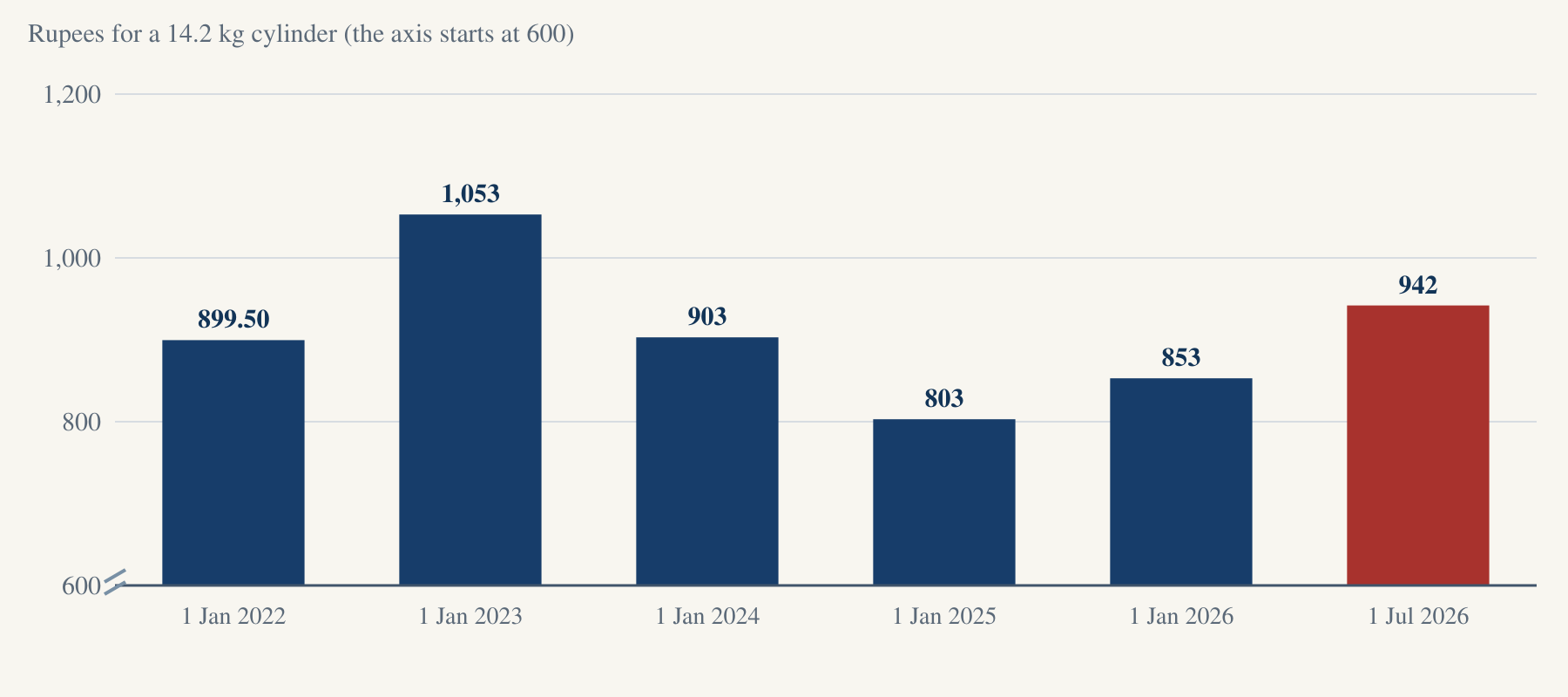
The price in Delhi was Rs 1,103 from 1 March 2023, Rs 903 from 30 August 2023 and Rs 803 from 9 March 2024. By 16 July 2025 it had risen to Rs 853. It then rose twice in 2026, by Rs 60 to Rs 913 from 7 March and by Rs 29 to Rs 942 from 7 June.
The Ministry told Parliament on 6 and 10 August 2026 that the price had been held at Rs 942 since June 2026. PPAC's price build-up gives the same Rs 942 on 1 October 2026. In 2026 the price rose by 10.4 per cent between 1 January and 1 July.
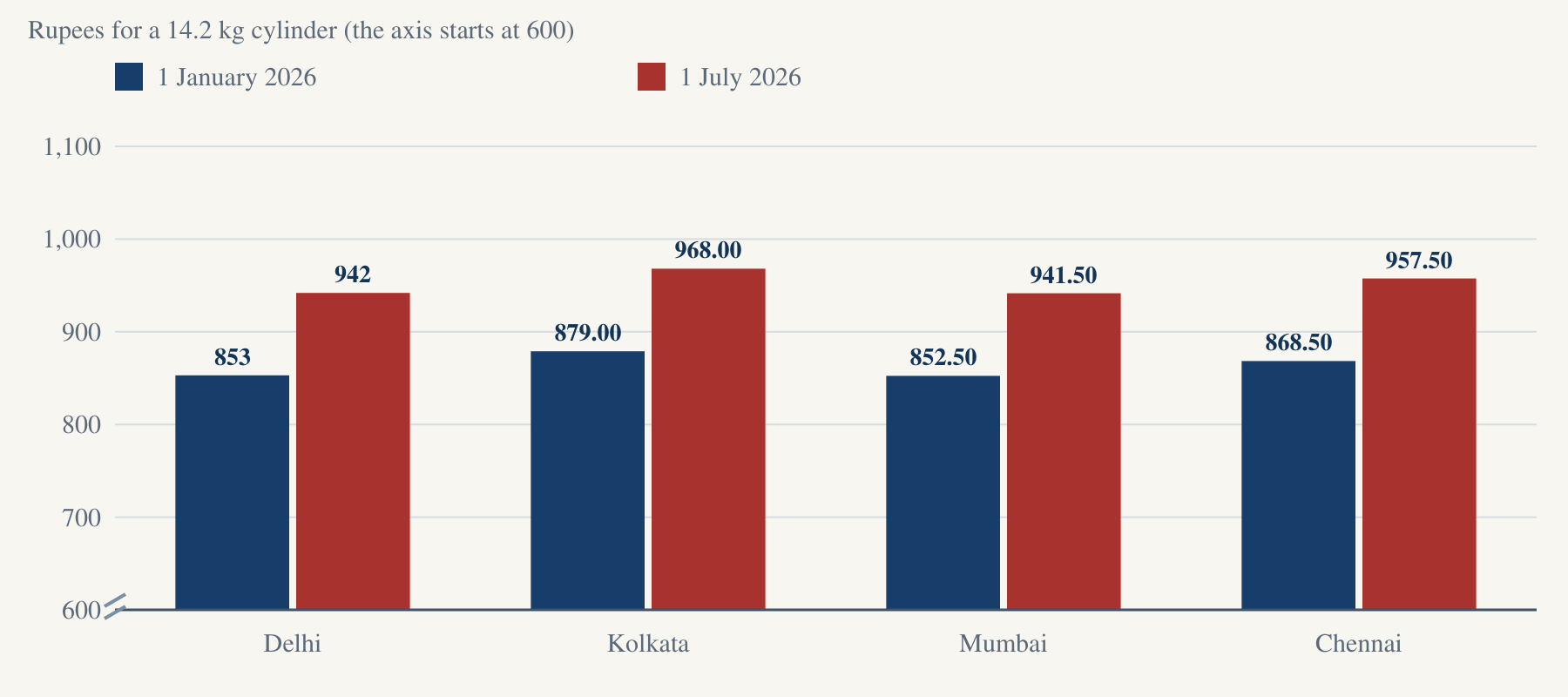
The rise was the same in each of the four metros. Between 1 January and 1 July 2026 the price went up by Rs 89 in Delhi, Kolkata, Mumbai and Chennai alike, as Indian Oil's table in the Ministry's answer shows.
MoSPI's consumer price index has one item for LPG cylinders and piped natural gas together, and it covers all India rather than Delhi alone. On the 2024 base the item stood at 104.31 in May 2026 and 106.71 in June. In September 2026 it stood at 107.13, which is 0.4 per cent above June.
Source: Rajya Sabha Unstarred Question 135, 20 July 2026 ; PPAC, Snapshot of India's Oil and Gas data, October 2026, file of 16 October 2026 ; Lok Sabha Unstarred Question 1652, 1 August 2024 ; Rajya Sabha Unstarred Question 128, 20 July 2026 ; MoSPI, consumer price index for June 2026 ; MoSPI, consumer price index for September 2026 .
The essentials
In May 2014, when the President appointed Shri Narendra Modi as Prime Minister, a Delhi household paid Rs 414 for a subsidised cylinder. PPAC's price build-up puts the 14.2 kg cylinder at Rs 942 in Delhi on 1 October 2026, which is Rs 528 more, or 127.5 per cent. The price reached Rs 942 on 7 June 2026, the highest retail price since August 2023. The Ministry gives Rs 942 as the effective cost for a household outside the Ujjwala scheme. In 2026 the Government cut the Ujjwala subsidy of Rs 300 a refill from 9 refills a year in 2025-26 to 4. Yet the Ministry told the Lok Sabha that an Ujjwala connection took 4.71 refills on average in 2025-26, the most in the five years it reported. No retail price of the household cylinder in Delhi between 30 August 2023 and 6 June 2026 was as high as Rs 942. The retail prices the Ministry gave Parliament for that period were Rs 903 on 1 January 2024, Rs 803 on 1 August 2024, Rs 853 on 16 July 2025 and Rs 913 from 7 March 2026.
Source: Rajya Sabha Unstarred Question 3812, 13 August 2014 ; PPAC, Snapshot of India's Oil and Gas data, October 2026, file of 16 October 2026 ; Rajya Sabha Unstarred Question 2527, 10 August 2026 ; Rajya Sabha Unstarred Question 135, 20 July 2026 ; Lok Sabha Unstarred Question 757, 23 July 2026 ; Lok Sabha Unstarred Question 734, 23 July 2026 .
The household cylinder
The household cylinder in Delhi reached Rs 942 on 7 June 2026, the highest retail price since August 2023. PPAC's price build-up gives the same Rs 942 on 1 October 2026. The rise was the same in each of the four metros.
Source: Rajya Sabha Unstarred Question 135, 20 July 2026 ; PPAC, Snapshot of India's Oil and Gas data, October 2026, file of 16 October 2026 ; Rajya Sabha Unstarred Question 128, 20 July 2026 .
Ujjwala households
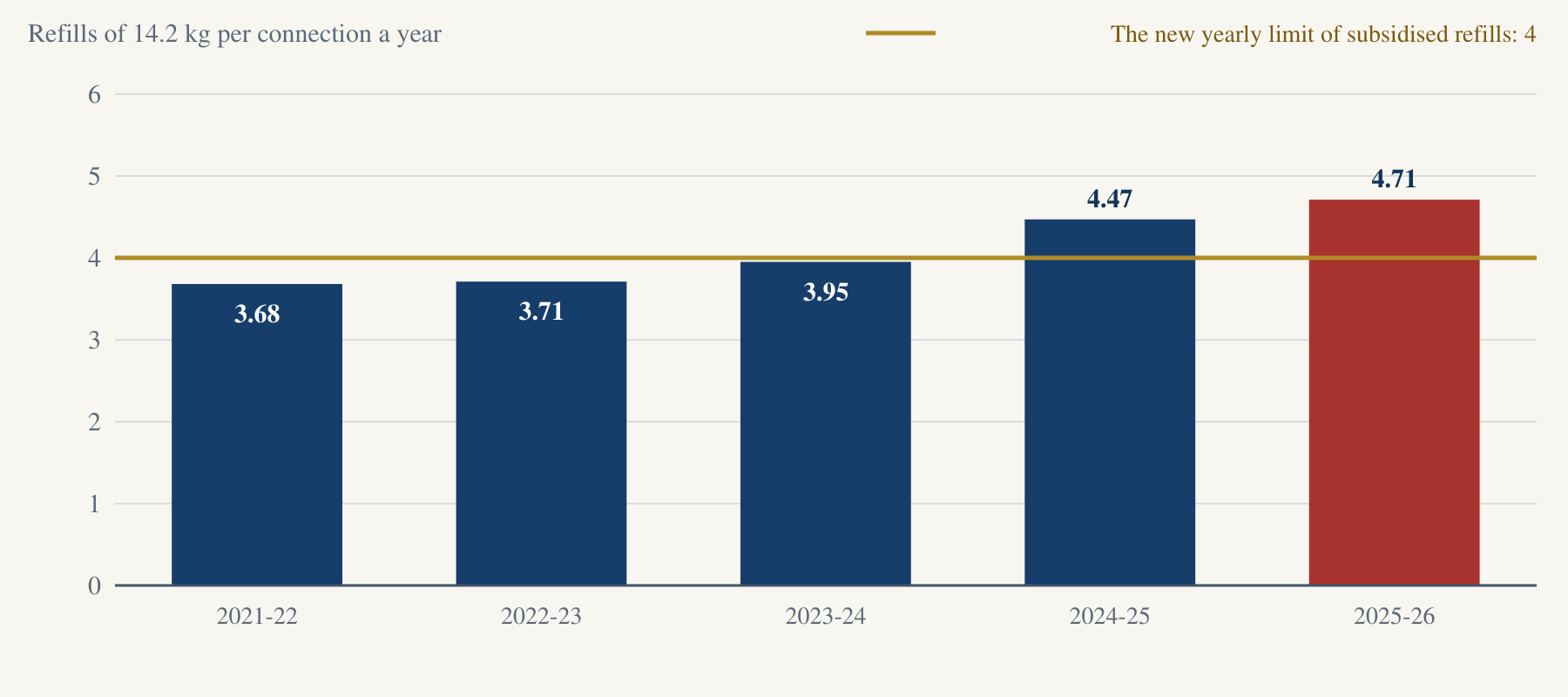
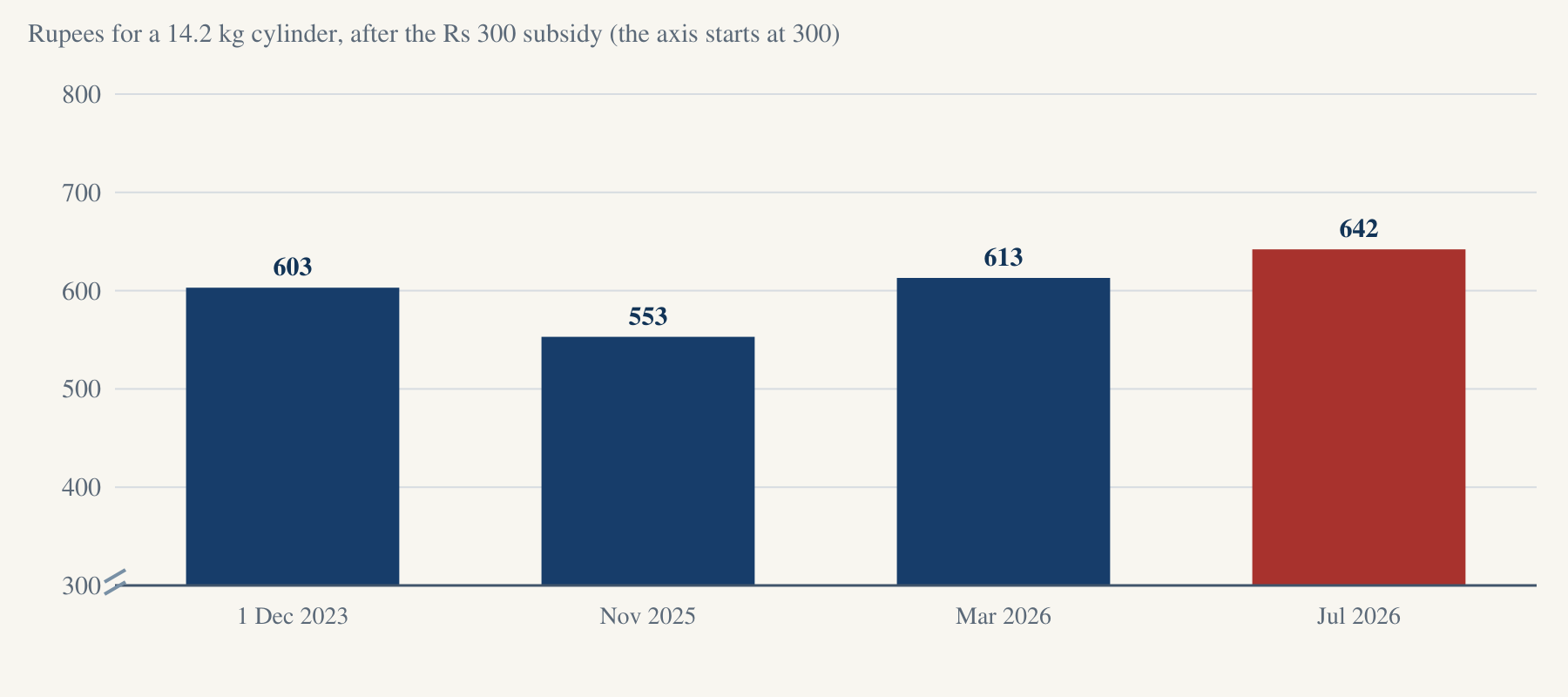
The limit of subsidised refills fell from 9 a year in 2025-26 to 4 in 2026, so the most subsidy that an Ujjwala household can receive in a year fell from Rs 2,700 in 2025-26 to Rs 1,200 in 2026. A subsidised refill cost Rs 642 in July 2026, against Rs 553 in November 2025.
Source: Lok Sabha Unstarred Question 757, 23 July 2026 ; Rajya Sabha Unstarred Question 128, 20 July 2026 ; Lok Sabha Starred Question 175, 11 December 2025 .
Since May 2014
Each consumer could buy 12 subsidised cylinders a year from 1 April 2014, and in May 2014 a Delhi household paid Rs 414 for each. PPAC's price build-up puts the cylinder at Rs 942 on 1 October 2026, which is 2.3 times as much.
Source: Lok Sabha Unstarred Question 450, 14 July 2014 ; Rajya Sabha Unstarred Question 3812, 13 August 2014 ; PPAC, Snapshot of India's Oil and Gas data, October 2026, file of 16 October 2026 .
The commercial cylinder
The 19 kg cylinder cost Rs 1,691.50 in Delhi on 1 January 2026. On 7 June 2026 it cost Rs 3,113.50, the Ministry said. That is 84.1 per cent more.
Source: Lok Sabha Unstarred Question 6426, 2 April 2026 ; PIB, Ministry of Petroleum and Natural Gas, 7 June 2026 .
Fewer cylinders
PPAC's consumption report for August 2026 says that 14.4 crore household cylinders of 14.2 kg were delivered that month, against 17.1 crore in August 2025. Ujjwala households used 22.7 per cent less LPG than a year earlier.
Source: PPAC, consumption report for August 2026 .
Airlines and households
On 3 June 2026 the Cabinet approved one-time support of up to Rs 10,000 crore, which goes to the oil companies. In the same year the Government cut the subsidised refills of an Ujjwala household, which fell from 9 a year to 4.
Source: PIB, Cabinet decision, 3 June 2026 ; Lok Sabha Unstarred Question 757, 23 July 2026 .
The household cylinder in Delhi
The price in Delhi was Rs 1,103 from 1 March 2023, Rs 903 from 30 August 2023 and Rs 803 from 9 March 2024. By 16 July 2025 it had risen to Rs 853. It then rose twice in 2026, by Rs 60 to Rs 913 from 7 March and by Rs 29 to Rs 942 from 7 June.
Source: Rajya Sabha Unstarred Question 128, 20 July 2026 . Each observation's dated source is linked in its CSV row.
View the figures in a table
| Observation | Value | Official source |
|---|---|---|
| 1 Jan 2022 | 899.50 | Rajya Sabha Unstarred Question 128, 20 July 2026 |
| 1 Jan 2023 | 1,053 | Rajya Sabha Unstarred Question 128, 20 July 2026 |
| 1 Jan 2024 | 903 | Rajya Sabha Unstarred Question 128, 20 July 2026 |
| 1 Jan 2025 | 803 | Rajya Sabha Unstarred Question 128, 20 July 2026 |
| 1 Jan 2026 | 853 | Rajya Sabha Unstarred Question 128, 20 July 2026 |
| 1 Jul 2026 | 942 | Rajya Sabha Unstarred Question 128, 20 July 2026 |
The same rise in all four metros
The rise was the same in each of the four metros. Between 1 January and 1 July 2026 the price went up by Rs 89 in Delhi, Kolkata, Mumbai and Chennai alike, as Indian Oil's table in the Ministry's answer shows.
Source: Rajya Sabha Unstarred Question 128, 20 July 2026 . Each observation's dated source is linked in its CSV row.
View the figures in a table
| Observation | Value | Official source |
|---|---|---|
| Delhi | 942 | Rajya Sabha Unstarred Question 128, 20 July 2026 |
| Kolkata | 968.00 | Rajya Sabha Unstarred Question 128, 20 July 2026 |
| Mumbai | 941.50 | Rajya Sabha Unstarred Question 128, 20 July 2026 |
| Chennai | 957.50 | Rajya Sabha Unstarred Question 128, 20 July 2026 |
On 1 July 2026 the cylinder cost Rs 968 in Kolkata, Rs 941.50 in Mumbai and Rs 957.50 in Chennai.
Ujjwala: four subsidised refills where nine were allowed
The Ministry told the Lok Sabha on 23 July 2026 that it had revised a yearly limit. The limit is on subsidised refills for Ujjwala households, and it went from 9 cylinders to 4. It kept the subsidy at Rs 300 a cylinder. That cuts the most subsidy that an Ujjwala household can receive in a year from Rs 2,700 to Rs 1,200.
Source: Lok Sabha Unstarred Question 3151, 6 August 2026 ; Lok Sabha Unstarred Question 757, 23 July 2026 . Each observation's dated source is linked in its CSV row.
View the figures in a table
| Observation | Value | Official source |
|---|---|---|
| 2021-22 | 3.68 | Lok Sabha Unstarred Question 3151, 6 August 2026 |
| 2022-23 | 3.71 | Lok Sabha Unstarred Question 3151, 6 August 2026 |
| 2023-24 | 3.95 | Lok Sabha Unstarred Question 3151, 6 August 2026 |
| 2024-25 | 4.47 | Lok Sabha Unstarred Question 3151, 6 August 2026 |
| 2025-26 | 4.71 | Lok Sabha Unstarred Question 3151, 6 August 2026 |
In the same session the Ministry gave the average for 2025-26 as 4.71 refills a connection. That is the highest of the five years in its table, which begins at 3.68 refills in 2021-22. The new limit of 4 sits 0.71 of a refill below the average of 2025-26, which was 4.71. The Ministry's own table shows that 4.85 crore Ujjwala consumers took more than four refills in 2025-26. That is 45.9 per cent of the 10.58 crore connections it counts for that year.
What an Ujjwala household pays
An Ujjwala household paid Rs 642 in Delhi for each subsidised refill in July 2026, after the subsidy of Rs 300 a refill. The price was Rs 553 in November 2025, so a subsidised refill rose by Rs 89, or 16.1 per cent. Every refill beyond the fourth costs the full Rs 942.
Source: Lok Sabha Starred Question 175, 11 December 2025 ; Rajya Sabha Unstarred Question 128, 20 July 2026 . Each observation's dated source is linked in its CSV row.
View the figures in a table
| Observation | Value | Official source |
|---|---|---|
| 1 Dec 2023 | 603 | Rajya Sabha Unstarred Question 1739, 18 December 2023 |
| Nov 2025 | 553 | Lok Sabha Starred Question 175, 11 December 2025 |
| Mar 2026 | 613 | Rajya Sabha Unstarred Question 4134, 30 March 2026 |
| Jul 2026 | 642 | Rajya Sabha Unstarred Question 128, 20 July 2026 |
Take an Ujjwala household that uses 4.71 refills in a year, the average for 2025-26. At the price of November 2025 its year's cylinders cost Rs 2,605, when up to nine refills carried the subsidy. At the prices of July 2026 it pays Rs 642 for each of four refills and Rs 942 for the rest, a total of Rs 3,237. That is Rs 632 more in a year, or 24.3 per cent.
Since May 2014
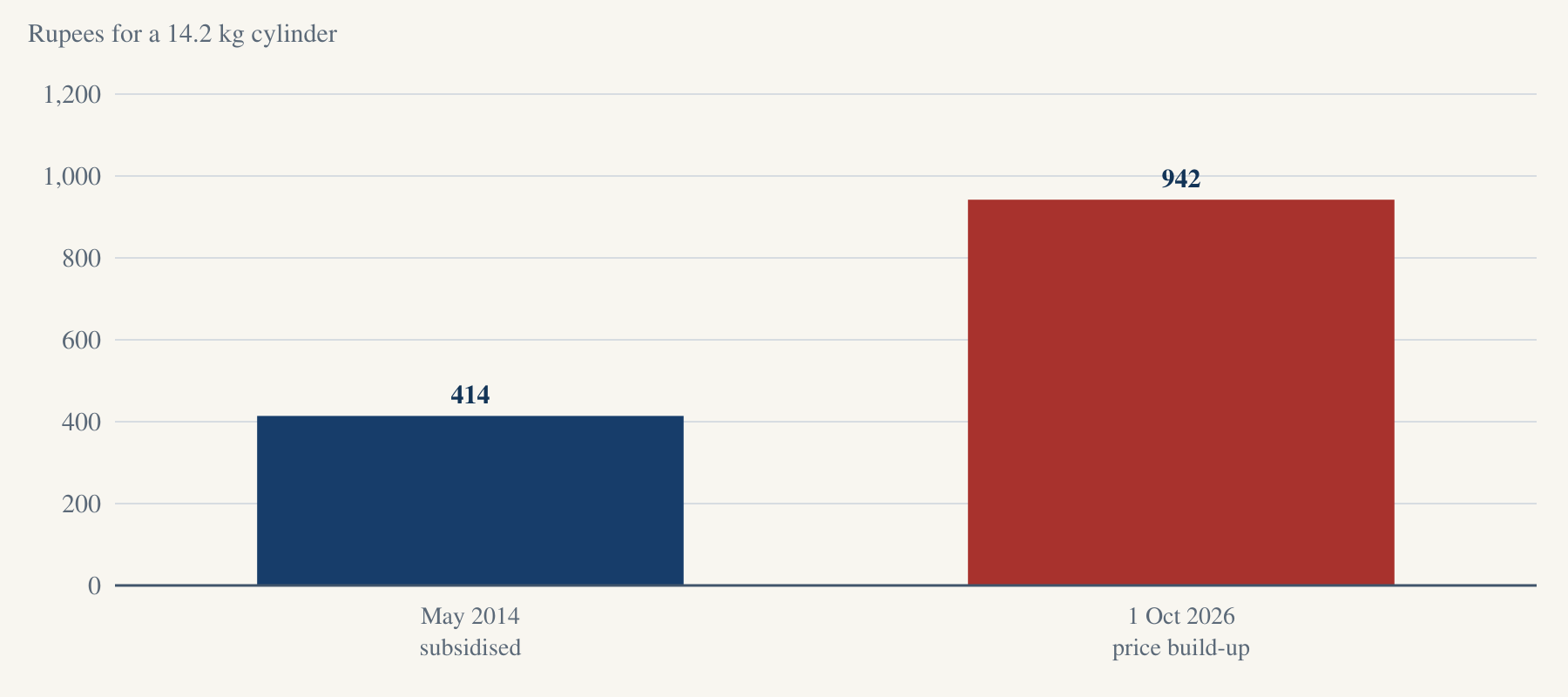
On 26 May 2014 the President appointed Shri Narendra Modi as Prime Minister. That month a Delhi household paid Rs 414 for a subsidised 14.2 kg cylinder. The Ministry's table of every revision shows the price at Rs 414 from 11 December 2013, and it lists no change up to its answer of 13 August 2014. PPAC's price build-up puts the cylinder at Rs 942 in Delhi on 1 October 2026. That is Rs 528 more, or 127.5 per cent, and 2.3 times as much. The Ministry gives Rs 942 as the effective cost for a household outside the Ujjwala scheme, from 7 June 2026.
Source: Rajya Sabha Unstarred Question 3812, 13 August 2014 ; PIB, President's Secretariat, 26 May 2014 ; PPAC, Snapshot of India's Oil and Gas data, October 2026, file of 16 October 2026 ; Rajya Sabha Unstarred Question 2527, 10 August 2026 ; Lok Sabha Unstarred Question 450, 14 July 2014 ; Lok Sabha Unstarred Question 757, 23 July 2026 . Each observation's dated source is linked in its CSV row.
View the figures in a table
| Observation | Value | Official source |
|---|---|---|
| May 2014 subsidised | 414 | Rajya Sabha Unstarred Question 3812, 13 August 2014 |
| 1 Oct 2026 price build-up | 942 | PPAC, Snapshot of India's Oil and Gas data, October 2026, file of 16 October 2026 |
The Ministry told the Lok Sabha on 14 July 2014 that from 1 April 2014 each consumer could buy 12 cylinders a year at the subsidised price. In 2026 the targeted subsidy of Rs 300 a refill goes only to Ujjwala households, and it covers 4 refills a year.
The commercial cylinder
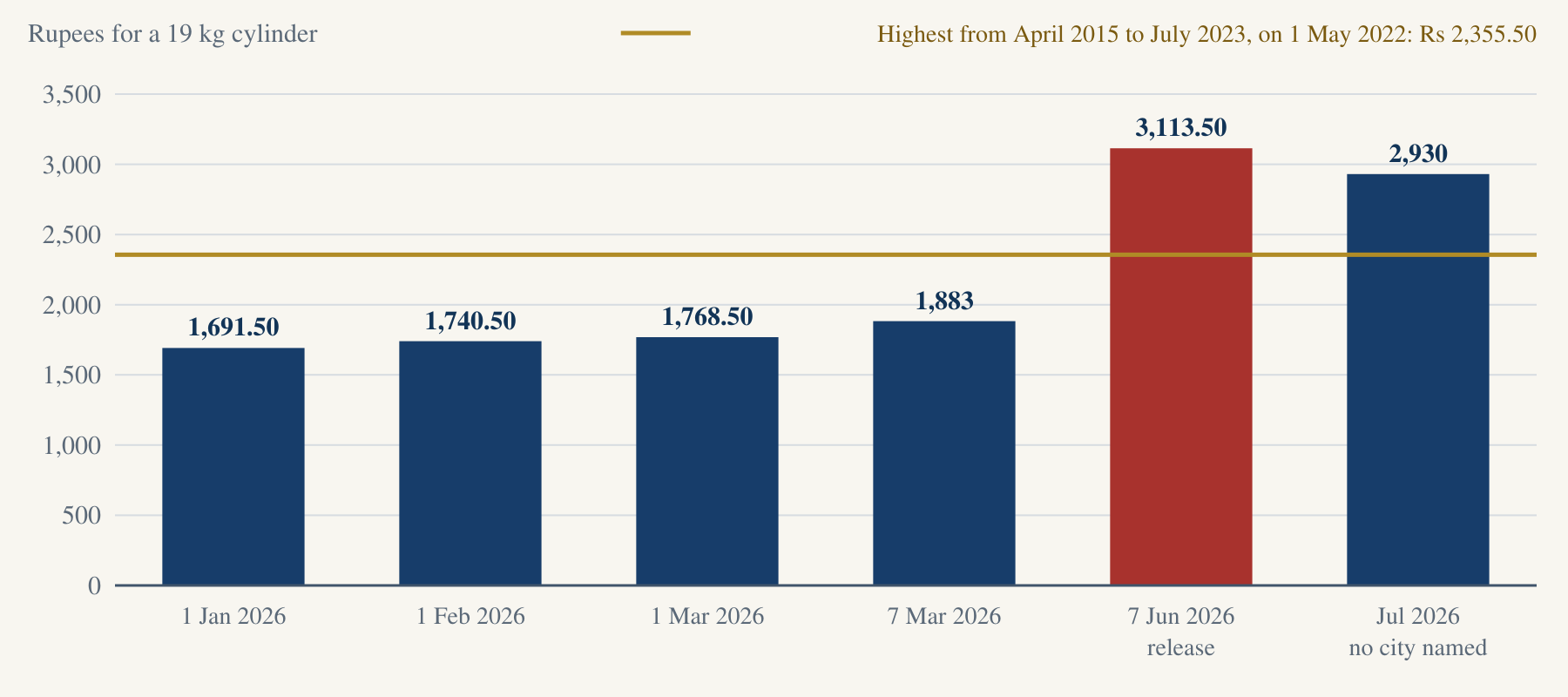
The 19 kg cylinder used by hotels and restaurants cost Rs 1,691.50 in Delhi on 1 January 2026. The Ministry's release of 7 June 2026 says it sold in Delhi at Rs 3,113.50. That is 84.1 per cent more than on 1 January. The Ministry told the Lok Sabha on 30 July 2026 that the oil companies revised the price of a 19 kg cylinder to Rs 2,930 in July 2026, and its answer names no city. That price is 73.2 per cent above the Delhi price of 1 January.
Source: Lok Sabha Unstarred Question 6426, 2 April 2026 ; PIB, Ministry of Petroleum and Natural Gas, 7 June 2026 ; Lok Sabha Unstarred Question 2033, 30 July 2026 . Each observation's dated source is linked in its CSV row.
View the figures in a table
| Observation | Value | Official source |
|---|---|---|
| 1 Jan 2026 | 1,691.50 | Lok Sabha Unstarred Question 6426, 2 April 2026 |
| 1 Feb 2026 | 1,740.50 | Lok Sabha Unstarred Question 6426, 2 April 2026 |
| 1 Mar 2026 | 1,768.50 | Lok Sabha Unstarred Question 6426, 2 April 2026 |
| 7 Mar 2026 | 1,883 | Lok Sabha Unstarred Question 6426, 2 April 2026 |
| 7 Jun 2026 release | 3,113.50 | PIB, Ministry of Petroleum and Natural Gas, 7 June 2026 |
| Jul 2026 no city named | 2,930 | Lok Sabha Unstarred Question 2033, 30 July 2026 |
The June price was Rs 758 above the peak of Rs 2,355.50 on 1 May 2022. That peak was the highest price in the Ministry's table of commercial prices, which runs from April 2015 to July 2023.
Fewer cylinders reached kitchens
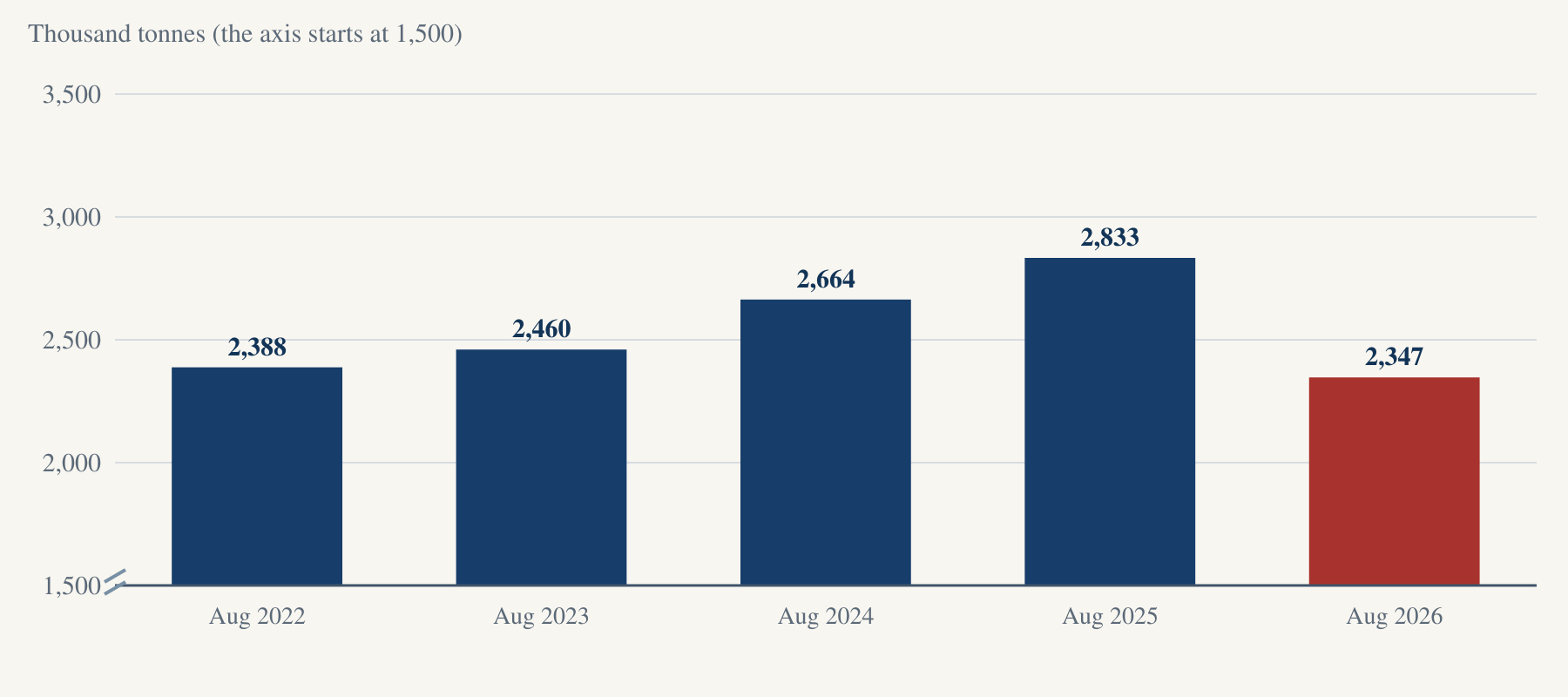
PPAC's consumption report for August 2026 says that 14.4 crore household cylinders of 14.2 kg were delivered that month, against 17.1 crore in August 2025. That is 2.7 crore fewer, or 15.8 per cent.
Source: PPAC, consumption report for August 2026 . Each observation's dated source is linked in its CSV row.
View the figures in a table
| Observation | Value | Official source |
|---|---|---|
| Aug 2022 | 2,388 | PPAC, consumption report for August 2026 |
| Aug 2023 | 2,460 | PPAC, consumption report for August 2026 |
| Aug 2024 | 2,664 | PPAC, consumption report for August 2026 |
| Aug 2025 | 2,833 | PPAC, consumption report for August 2026 |
| Aug 2026 | 2,347 | PPAC, consumption report for August 2026 |
The same report puts packed domestic LPG consumption 15.9 per cent below August 2025. Consumption by Ujjwala households was 22.7 per cent lower. India used 2,347 thousand tonnes of LPG in August 2026. That is the lowest of the five Augusts in PPAC's table.
The Ministry told the Lok Sabha on 23 July 2026 that it had raised the booking interval. That interval became 25 days in urban areas, and up to 45 days in rural areas.
The Ministry's release of 19 September 2026 sets a condition, which applies from 1 October 2026. From that day a household must complete biometric Aadhaar authentication before it can book a refill at the regulated price with its subsidy. A consumer who is unwilling or unable to complete it, and registers that choice with the oil company, is supplied LPG at the market price, without any subsidy, in 5 kg or 10 kg cylinders. By 19 September, 27.43 crore active consumers, or 89.9 per cent, had completed it. On the release's own percentage, that leaves about 3.1 crore active consumers who had not.
Aviation fuel: a stable price for airlines
On 3 June 2026 the Cabinet approved one-time support of up to Rs 10,000 crore, which goes to the oil companies. It is meant to give scheduled Indian airlines a stable price for aviation turbine fuel, which is called ATF. The support takes the form of interest-free advances to the oil companies. In the same year the Government cut the subsidised refills of an Ujjwala household, which fell from 9 a year to 4.
The Ministry of Civil Aviation told the Rajya Sabha on 20 July 2026 that, under this arrangement, one uniform FOB price of ATF, as the answer calls it, was applied across the country. It was Rs 86.32 a litre for domestic operations, and Rs 104.49 a litre for international operations. For April and May 2026 the Government capped the price of ATF for domestic flights. It could rise by at most 25 per cent over its level of 1 March 2026.
A household that takes 4.71 refills in a year, the Ujjwala average for 2025-26, pays this much for the year's cylinders.
Source: this brief's arithmetic on Lok Sabha Unstarred Question 3151, 6 August 2026, Lok Sabha Starred Question 175, 11 December 2025 and Rajya Sabha Unstarred Question 128, 20 July 2026.
What the revision of 1 November 2026 will be read against
The oil companies revise LPG and ATF prices on the first of each month. This brief fills in no figure for that day, and the table gives the latest price the Government has stated for each item.
| Item | The price applies to | The Government's latest statement of it | Price |
|---|---|---|---|
| Household cylinder, Delhi | from 7 June 2026 | 6 and 10 August 2026, the Ministry in Parliament | Rs 942 |
| Household cylinder, Delhi | 1 October 2026 | PPAC's price build-up, Snapshot of October 2026 | Rs 942 |
| Household cylinder, Kolkata | 1 July 2026 | 20 July 2026 | Rs 968 |
| Household cylinder, Mumbai | 1 July 2026 | 20 July 2026 | Rs 941.50 |
| Household cylinder, Chennai | 1 July 2026 | 20 July 2026 | Rs 957.50 |
| Ujjwala refill, Delhi, up to four a year | July 2026 | 20 July 2026, and again in August 2026 | Rs 642 |
| Commercial 19 kg cylinder, no city named | July 2026 | 30 July 2026 | Rs 2,930 |
| ATF for domestic operations, the uniform FOB price under the stabilisation arrangement | the arrangement approved on 3 June 2026 | 20 July 2026 | Rs 86.32 a litre |
The latest Government statement of the Delhi household price is PPAC's price build-up of 1 October 2026, which gives Rs 942. How long Rs 942 has held, and whether a new price on 1 November is the highest retail price since August 2023, also depend on the oil companies' notices of 1 August and 1 September 2026, which are not among this brief's sources. The notice of 1 November gives ATF in rupees a kilolitre for each city, so it can be read against Indian Oil's monthly base price at New Delhi only if the notice gives the same measure, and never against the FOB price of Rs 86.32 a litre. The Ministry last stated the limit of 4 subsidised Ujjwala refills a year on 10 August 2026, and a change in the price on 1 November would not by itself change that limit.
The Government's own figures put the household cylinder in Delhi at Rs 942 on 1 October 2026, which is 2.3 times the Rs 414 a household paid for a subsidised cylinder in May 2014. They also show the Ujjwala subsidy cut in 2026 to 4 refills a year. That is below the 4.71 refills an Ujjwala connection took on average in 2025-26.
Terms, explained
- Household cylinder
- The 14.2 kg domestic LPG cylinder that a household buys for its kitchen. Its price here is the retail selling price in Delhi unless a city is named.
- Commercial cylinder
- The 19 kg LPG cylinder used by hotels, restaurants and other businesses, which the oil companies price separately each month.
- Ujjwala
- The Pradhan Mantri Ujjwala Yojana (PMUY), which gives LPG connections to women from poor households. Its households receive a targeted subsidy on a limited number of refills.
- Effective price
- What an Ujjwala household pays for a subsidised refill, which is the retail price less the targeted subsidy of Rs 300.
- ATF
- Aviation turbine fuel, the fuel that airlines buy, priced by the oil companies each month.
- PPAC
- The Petroleum Planning and Analysis Cell, the Ministry of Petroleum and Natural Gas's own office of statistics.
Downloads for readers and the press
Sources & method
Every price in this brief is the Government's own figure, which the Ministry of Petroleum and Natural Gas or the Ministry of Civil Aviation gave to Parliament, or a PIB release published. The Ministry's answers reproduce Indian Oil's price tables and the tables of the Petroleum Planning and Analysis Cell (PPAC), which is the Ministry's own office of statistics.
The household cylinder is the 14.2 kg domestic LPG cylinder, and its price is the retail selling price in Delhi unless a city is named. The commercial cylinder weighs 19 kg. An Ujjwala household is one that has a connection under the Pradhan Mantri Ujjwala Yojana (PMUY). Its effective price is what it pays after the targeted subsidy of Rs 300 a refill.
This brief works out four kinds of figure from the Government's own. They are the change between two prices and the change in per cent. They are also the cost of a year's refills for an Ujjwala household at the 2025-26 average, and the highest or lowest value of a series. The brief prints every other figure as the Government prints it.
The oil companies' monthly price notices of August, September and October 2026 are not among this brief's sources. Its latest household price is PPAC's price build-up of domestic LPG at Delhi as on 1 October 2026, and its other latest prices are those the Government stated in Parliament in July and August 2026.
MoSPI's consumer price index has one item for LPG cylinders and piped natural gas together, for all India. This brief uses it only as a check, because it is neither a Delhi price nor a price of the cylinder alone.
- Rajya Sabha Unstarred Question 135, 20 July 2026 .
- PPAC, Snapshot of India's Oil and Gas data, October 2026, file of 16 October 2026 .
- Rajya Sabha Unstarred Question 128, 20 July 2026 .
- Lok Sabha Unstarred Question 3151, 6 August 2026 .
- Rajya Sabha Unstarred Question 2527, 10 August 2026 .
- Lok Sabha Unstarred Question 757, 23 July 2026 .
- Lok Sabha Unstarred Question 734, 23 July 2026 .
- Lok Sabha Starred Question 175, 11 December 2025 .
- Rajya Sabha Unstarred Question 147, 21 July 2025 .
- Rajya Sabha Unstarred Question 4134, 30 March 2026 .
- Lok Sabha Unstarred Question 1652, 1 August 2024 .
- Rajya Sabha Unstarred Question 1739, 18 December 2023 .
- Lok Sabha Starred Question 203, 3 August 2023 .
- Lok Sabha Unstarred Question 6426, 2 April 2026 .
- Lok Sabha Unstarred Question 2033, 30 July 2026 .
- Lok Sabha Unstarred Question 1881, 30 July 2026 .
- PIB, Ministry of Petroleum and Natural Gas, 7 June 2026 .
- PPAC, consumption report for August 2026 .
- PIB, Ministry of Petroleum and Natural Gas, 19 September 2026 .
- PIB, Cabinet decision, 3 June 2026 .
- Rajya Sabha Unstarred Question 7, 20 July 2026 .
- MoSPI, consumer price index for May 2026 .
- MoSPI, consumer price index for June 2026 .
- MoSPI, consumer price index for July 2026 .
- MoSPI, consumer price index for August 2026 .
- MoSPI, consumer price index for September 2026 .
- Rajya Sabha Unstarred Question 3812, 13 August 2014 .
- Lok Sabha Unstarred Question 585, 14 July 2014 .
- Lok Sabha Unstarred Question 450, 14 July 2014 .
- PIB, President's Secretariat, 26 May 2014 .