The promise and the reply
On 15 August 2021, in his address from the Red Fort, the Prime Minister said that PM GatiShakti's national master plan would soon be launched, and in the next sentence he described the scheme in his own Hindi words:
“सौ लाख करोड़ से भी अधिक की यह योजना लाखों नौजवानों के लिए रोजगार के नए अवसर लेकर आने वाली है”The Prime Minister's Office published this English rendering: “This scheme of more than 100 lakh crores rupees will result in new employment opportunities for lakhs of youth.”
At the launch of PM GatiShakti on 13 October 2021, the Prime Minister said that India was “taking every step so that projects do not get delayed, there are no obstacles and work is completed on time”.
On 28 February 2022, at a post-budget webinar on the vision of GatiShakti, the Prime Minister said of PM GatiShakti: “This will also bring down the time and cost overrun of the projects”. The Ministry of Petroleum and Natural Gas reported his words the same day.
On 11 August 2026, the Ministry of Commerce and Industry told the Lok Sabha in a written reply that “no quantified targets or expenditure requirements have been set under PM GatiShakti initiative”.
Source: PIB, Red Fort address, 15 August 2021, Hindi ; PIB, Red Fort address, 15 August 2021, English ; PIB, address at the launch, 13 October 2021 ; PIB, webinar on GatiShakti, 28 February 2022 ; PIB, Lok Sabha written reply, 11 August 2026 .
The pages that follow set out what the Government's own monthly reports record about the central projects approved since the launch.
The essentials
The Ministry of Statistics and Programme Implementation publishes a Flash Report every month on the central projects that cost Rs 150 crore or more. Each report lists those projects with their original cost and date of commissioning, their latest cost and date, and what has been spent on them.
555 of the 599 central projects approved since October 2021 and due by August 2026, counting those still under way in August 2026 and those completed by then, ran late. Among the 1,061 projects still under way in August 2026 whose original date had already passed, 1,056 ran late. From October 2021 to August 2026, the 3,179 projects under way in August 2026 or completed in that time, leaving out BharatNet, came to cost a net Rs 3.49 lakh crore more than when they entered the reports, which is a rise of 7.4 per cent.
Source: MoSPI Flash Report, August 2026, released 25 September 2026 ; MoSPI Flash Reports, October 2021 to August 2026 .
1,056 of 1,061 late
In August 2026, 1,061 projects were still under way after their original date had passed. Of those, 1,056 were late, and only 4 were on time or early.
Source: MoSPI Flash Report, August 2026, released 25 September 2026 .
Cost up Rs 3.49 lakh crore in the period
From October 2021 to August 2026, the 3,179 projects under way in August 2026 or completed in that time, leaving out BharatNet, came to cost a net Rs 3.49 lakh crore more than when they entered the reports, which is a rise of 7.4 per cent.
Railways: cost up 35.2 per cent in the period
The 272 railway projects that were under way in August 2026, or finished between October 2021 and August 2026, now cost Rs 1.49 lakh crore more than they did when they first entered the reports. That is a rise of 35.2 per cent.
Overrun tables gone
The May 2024 report was the last to print tables of cost and time overrun. The reports for July and August 2026 no longer list 114 railway projects that earlier reports carried, among them the Mumbai-Ahmedabad high speed rail project.
Source: MoSPI Flash Report, May 2024 ; MoSPI Flash Report, August 2026, released 25 September 2026 .
Projects approved since the launch
The Government's own Flash Reports list 599 central projects that were approved in October 2021 or later, were due by August 2026, and were either still under way in August 2026 or completed by then. Of those 599 projects, which were under way or completed, 555 ran late, which is 92.7 per cent, and 44 did not.
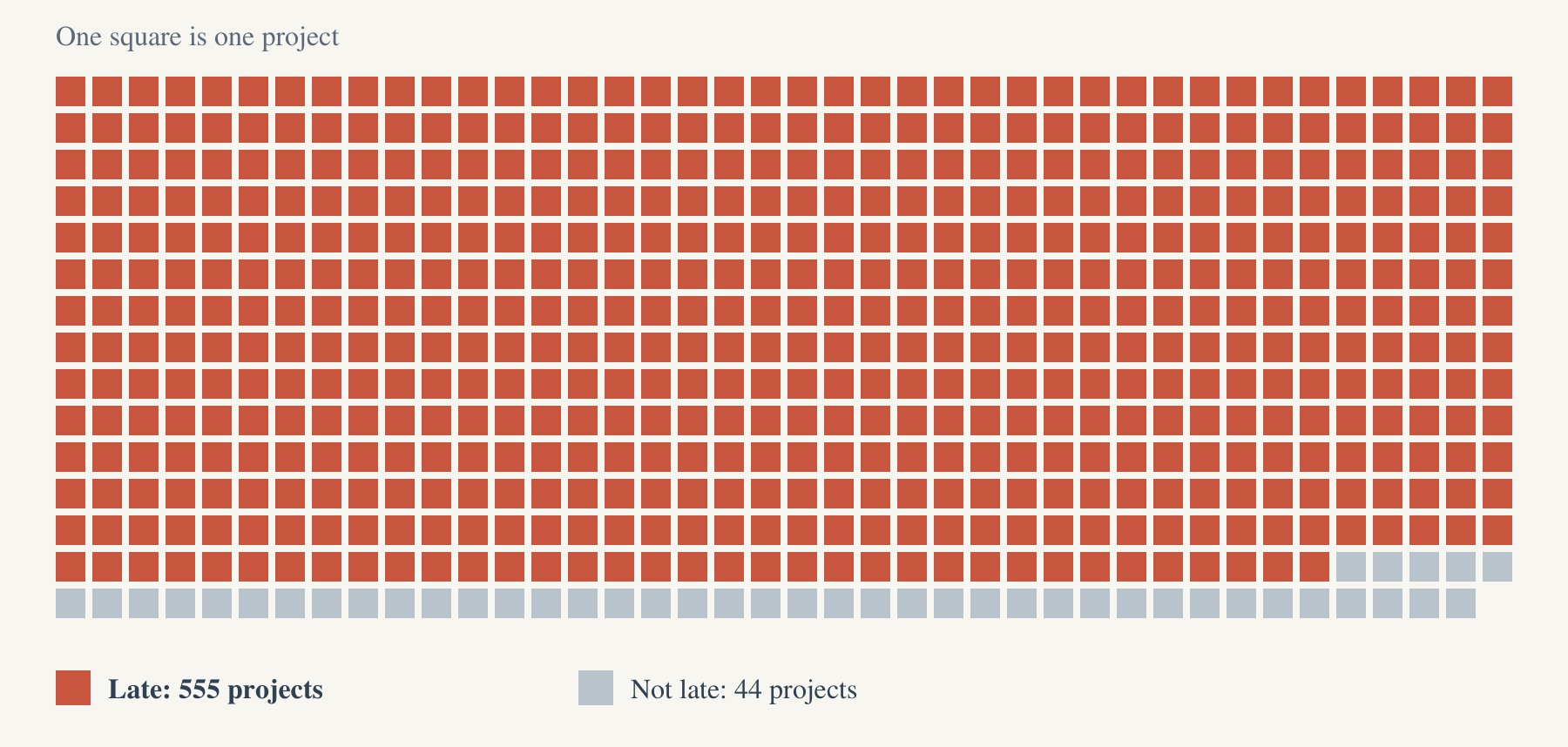
Source: MoSPI Flash Report, August 2026, released 25 September 2026 ; MoSPI Flash Reports, October 2021 to August 2026 ; MoSPI archive, Flash Report, October 2021 . Each figure's public source is linked in its CSV row.
View the figures in a table
| Observation | Value | Official source |
|---|---|---|
| Due by August 2026, under way or completed | 599 | 2026-09-25 |
| Of those, ran late | 555 | 2026-09-25 |
Still under way, past the original date
In August 2026, 1,061 central projects were still under way although their original date of commissioning had passed. Of these, 1,056 were late, only 4 were on time or early, and one is left out because its printed original date falls before its date of approval. More than half of the 1,056 late projects were over two years behind their original date, 190 were more than five years behind, and 26 were more than ten years behind.
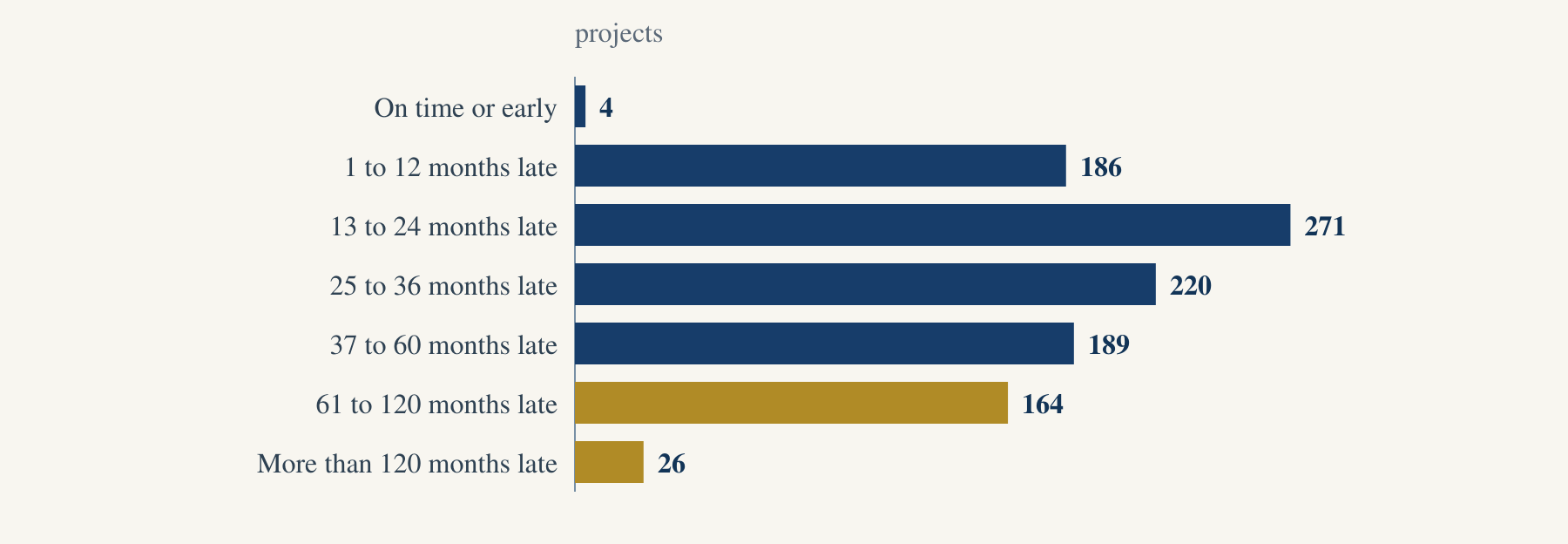
Source: MoSPI Flash Report, August 2026, released 25 September 2026 . Each figure's public source is linked in its CSV row.
View the figures in a table
| Observation | Value | Official source |
|---|---|---|
| On time or early | 4 | 2026-09-25 |
| 1 to 12 months late | 186 | 2026-09-25 |
| 13 to 24 months late | 271 | 2026-09-25 |
| 25 to 36 months late | 220 | 2026-09-25 |
| 37 to 60 months late | 189 | 2026-09-25 |
| 61 to 120 months late | 164 | 2026-09-25 |
| More than 120 months late | 26 | 2026-09-25 |
Taking every late project together, both those still under way and those completed, half have a delay of 27 months or more, where the delay is the gap between the original date of commissioning and the latest date.
Costs above the original
The 3,180 central projects that were still under way in August 2026 or were completed from October 2021 had an original cost of Rs 43.24 lakh crore, a sum that covers 3,179 of them because it leaves out BharatNet, which the Ministry of Statistics split into sub-projects in July 2026. Their latest cost is Rs 50.75 lakh crore, which is Rs 7.51 lakh crore, or 17.4 per cent, above the original.
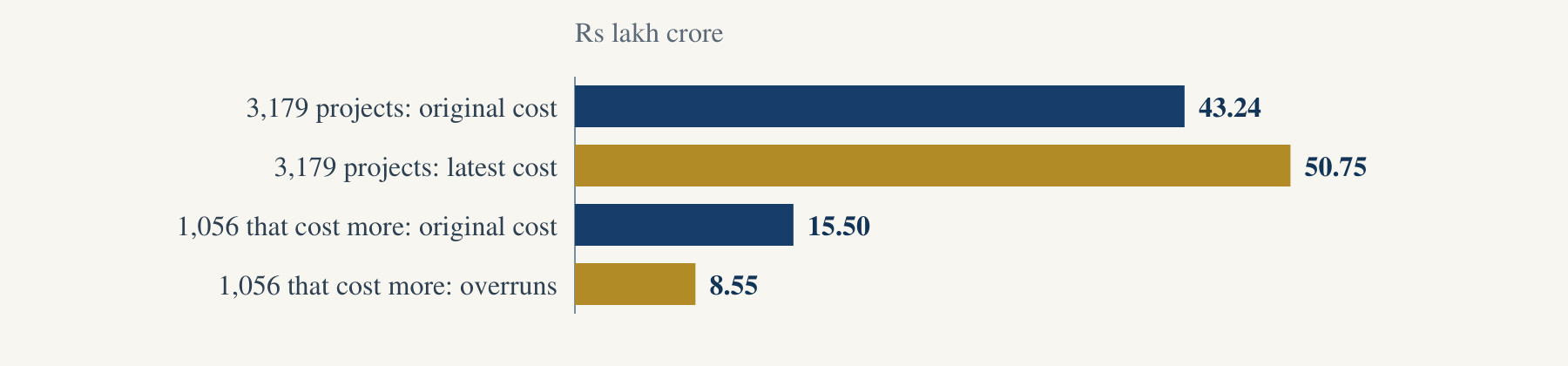
Source: MoSPI Flash Reports, October 2021 to August 2026 ; MoSPI Flash Report, August 2026, released 25 September 2026 . Each figure's public source is linked in its CSV row.
View the figures in a table
| Observation | Value | Official source |
|---|---|---|
| 3,179 projects: original cost | 43.24 | 2026-09-25 |
| 3,179 projects: latest cost | 50.75 | 2026-09-25 |
| 1,056 that cost more: original cost | 15.5 | 2026-09-25 |
| 1,056 that cost more: overruns | 8.55 | 2026-09-25 |
Of these projects, 1,056 cost more than their original cost. Their overruns add up to Rs 8.55 lakh crore, which is 55.1 per cent of their original cost of Rs 15.50 lakh crore.
The rise from October 2021 to August 2026
On 28 February 2022 the Prime Minister said of PM GatiShakti: “This will also bring down the time and cost overrun of the projects”. The Government's own reports show how much the cost of these projects rose while they sat in those reports. From October 2021 to August 2026, the cost of the 3,179 projects under way in August 2026 or completed in that time, leaving out BharatNet, went from Rs 47.26 lakh crore when they entered the reports to Rs 50.75 lakh crore. That is a net rise of Rs 3.49 lakh crore, or 7.4 per cent, and 706 of the projects grew costlier.
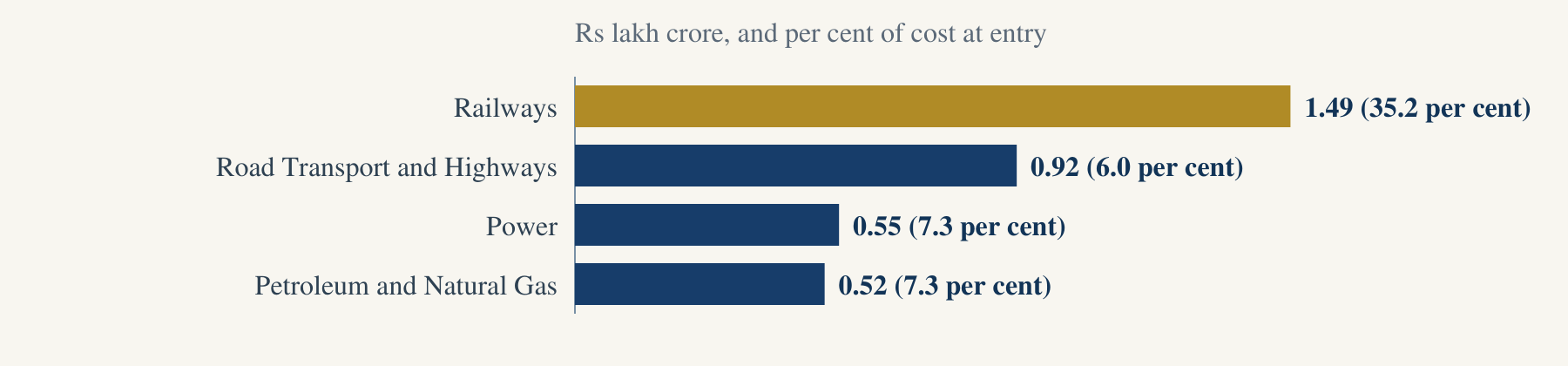
Source: PIB, webinar on GatiShakti, 28 February 2022 ; MoSPI Flash Reports, October 2021 to August 2026 ; MoSPI Flash Report, August 2026, released 25 September 2026 . Each figure's public source is linked in its CSV row.
View the figures in a table
| Observation | Value | Official source |
|---|---|---|
| Railways | 1.49 | 2026-09-25 |
| Road Transport and Highways | 0.92 | 2026-09-25 |
| Power | 0.55 | 2026-09-25 |
| Petroleum and Natural Gas | 0.52 | 2026-09-25 |
| Ministry | Rise, Rs lakh crore | Per cent of cost at entry | Projects whose cost rose |
|---|---|---|---|
| Railways | 1.49 | 35.2 | 133 |
| Road Transport and Highways | 0.92 | 6.0 | 388 |
| Power | 0.55 | 7.3 | 51 |
| Petroleum and Natural Gas | 0.52 | 7.3 | 63 |
Ministry by ministry
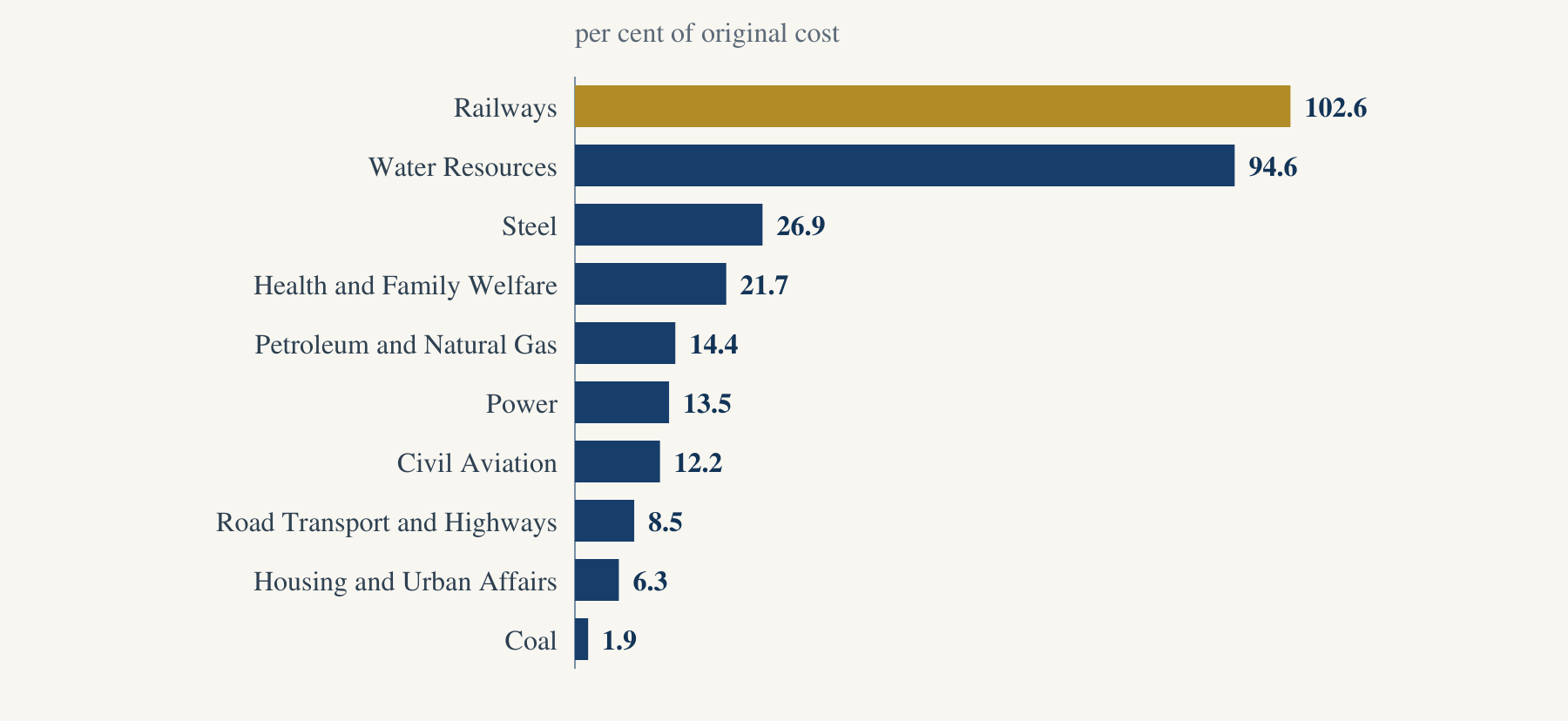
Railways carry the largest overrun, both in rupees and as a share of the original cost. The 272 railway projects under way in August 2026 or completed since October 2021 had an original cost of Rs 2,81,901 crore, and their latest cost is Rs 2,89,174 crore higher, which is 102.6 per cent, so the cost has more than doubled. Water Resources has the next highest share, 94.6 per cent, and Road Transport and Highways the next largest sum, Rs 1,27,870 crore. In Coal, every one of the 74 projects that were due ran late.
Source: MoSPI Flash Reports, October 2021 to August 2026 ; MoSPI Flash Report, August 2026, released 25 September 2026 . Each figure's public source is linked in its CSV row.
View the figures in a table
| Observation | Value | Official source |
|---|---|---|
| Railways | 102.6 | 2026-09-25 |
| Water Resources | 94.6 | 2026-09-25 |
| Steel | 26.9 | 2026-09-25 |
| Health and Family Welfare | 21.7 | 2026-09-25 |
| Petroleum and Natural Gas | 14.4 | 2026-09-25 |
| Power | 13.5 | 2026-09-25 |
| Civil Aviation | 12.2 | 2026-09-25 |
| Road Transport and Highways | 8.5 | 2026-09-25 |
| Housing and Urban Affairs | 6.3 | 2026-09-25 |
| Coal | 1.9 | 2026-09-25 |
Each ministry or department in the table is one whose projects, taken together, cost more than their original cost. The median delay is the delay that half of its late projects reach or exceed.
| Ministry or department | Projects | Due | Late, per cent of due | Median delay of late projects, months | Overrun, Rs crore | Overrun, per cent |
|---|---|---|---|---|---|---|
| Railways | 272 | 192 | 81.8 | 40.5 | 2,89,174 | 102.6 |
| Road Transport and Highways | 1884 | 1480 | 92.0 | 28 | 1,27,870 | 8.5 |
| Water Resources | 63 | 60 | 98.3 | 55 | 1,04,161 | 94.6 |
| Power | 198 | 138 | 94.9 | 15 | 96,936 | 13.5 |
| Petroleum and Natural Gas | 294 | 200 | 91.5 | 20 | 96,448 | 14.4 |
| Housing and Urban Affairs | 76 | 58 | 89.7 | 37 | 29,168 | 6.3 |
| Steel | 37 | 19 | 89.5 | 11.5 | 13,063 | 26.9 |
| Health and Family Welfare | 47 | 31 | 93.5 | 29 | 5,819 | 21.7 |
| Coal | 145 | 74 | 100.0 | 38.5 | 5,091 | 1.9 |
| Civil Aviation | 33 | 27 | 96.3 | 13 | 3,139 | 12.2 |
| Mines | 6 | 6 | 100.0 | 64 | 2,604 | 26.7 |
| Industry and Internal Trade (DPIIT) | 14 | 3 | 66.7 | 53 | 1,187 | 4.8 |
| Higher Education | 41 | 27 | 92.6 | 24 | 414 | 2.3 |
| Labour and Employment | 15 | 12 | 100.0 | 13 | 266 | 7.4 |
| Ports, Shipping and Waterways | 11 | 8 | 87.5 | 24 | 229 | 1.3 |
| Renewable Energy | 1 | 1 | 100.0 | 29 | 94 | 34.6 |
| Finance | 1 | 1 | 100.0 | 36 | 53 | 25.4 |
| Home Affairs | 2 | 2 | 100.0 | 51 | 48 | 13.3 |
Source: MoSPI Flash Reports, October 2021 to August 2026 ; download the table (CSV).
What the reports stopped printing
The monthly reports once printed tables of cost overrun and of time overrun, by sector and by state. The May 2024 report was the last to carry those tables, and none of the 27 reports from June 2024 to August 2026 uses the word overrun.
Until June 2025 the reports printed an anticipated cost, which is the cost a project was then expected to reach on completion. From July 2025 they print only the costs that have been formally approved, so a rise in the expected cost reaches the page only after that approval. For 172 projects still under way, the last anticipated cost printed was higher than the cost printed now, by Rs 39,270 crore in all.
| What the reports printed | Last printed in the report for | Report |
|---|---|---|
| Tables of cost overrun and time overrun | May 2024 | MoSPI Flash Report, May 2024 |
| The anticipated cost of each project | June 2025 | MoSPI Flash Report, June 2025 |
| 114 railway projects, among them the Mumbai-Ahmedabad high speed rail project | June 2026 for 71, July 2026 for 43 | MoSPI Flash Report, July 2026 |
Source: MoSPI Flash Report, May 2024 ; MoSPI Flash Report, June 2025 ; MoSPI Flash Report, July 2025 .
Original costs that changed
For 354 projects under way in August 2026 or completed, a later report prints an original cost different from the one the earliest report printed, and in 261 of those the figure went up. Leaving out BharatNet, whose costs stay out of every rupee sum, the remaining 353 projects ran Rs 2,62,127 crore over their first original cost, and Rs 1,02,047 crore over the restated figure. The restatement keeps 61.1 per cent of that overrun out of view.

Source: MoSPI Flash Reports, October 2021 to August 2026 . Each figure's public source is linked in its CSV row.
View the figures in a table
| Observation | Value | Official source |
|---|---|---|
| On the first original cost printed | 2.62 | 2026-09-25 |
| On the restated original cost | 1.02 | 2026-09-25 |
Railway projects no longer listed
The reports for July and August 2026 no longer list 114 railway projects that earlier reports carried: 71 were last listed in June 2026 and 43 in July 2026. Their original costs add up to Rs 3,93,714 crore, and Rs 4,11,662 crore had been spent on them by the last report that listed them.
They include the Mumbai-Ahmedabad high speed rail project. The July 2026 report listed it at a cost of Rs 1,08,000 crore, with Rs 90,967 crore spent, and the August 2026 report does not list it.
Source: MoSPI Flash Report, July 2026 ; MoSPI Flash Report, August 2026, released 25 September 2026 ; download the figures (CSV).
Projects taken off the list
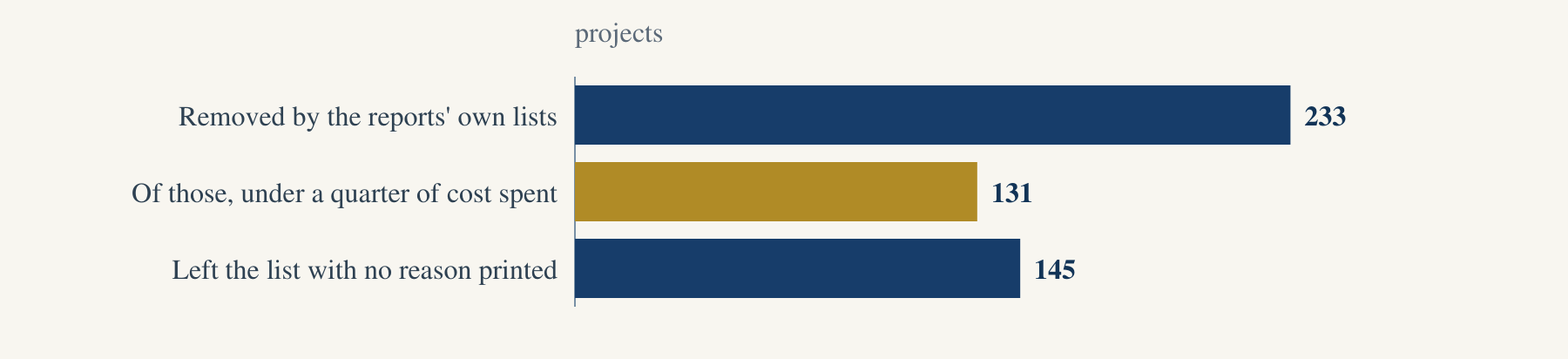
The reports' own lists name 233 projects as deleted, as frozen or deleted, or as “completed, dropped or frozen” without saying which, and the reports never say why a project was removed. Their original costs add up to Rs 2,13,461 crore, and Rs 83,797 crore had been spent on them.
Source: MoSPI Flash Reports, October 2021 to August 2026 . Each figure's public source is linked in its CSV row.
View the figures in a table
| Observation | Value | Official source |
|---|---|---|
| Removed by the reports' own lists | 233 | 2026-09-25 |
| Of those, under a quarter of cost spent | 131 | 2026-09-25 |
| Left the list with no reason printed | 145 | 2026-09-25 |
131 of the 233 had spent less than a quarter of their original cost when the reports removed them. Those 131 projects had original costs of Rs 1,33,615 crore, about Rs 1.34 lakh crore, and Rs 7,056 crore had been spent on them.
Another 145 projects left the list without appearing in any list of completed, deleted or frozen projects, and the reports print no reason for their going. Their original costs add up to Rs 1,53,742 crore, and Rs 86,346 crore had been spent on them.
| Projects | Count | Original cost, Rs crore | Spent, Rs crore |
|---|---|---|---|
| Named in the reports' own lists as deleted, frozen, or completed, dropped or frozen | 233 | 2,13,461 | 83,797 |
| Of those, less than a quarter of the cost spent | 131 | 1,33,615 | 7,056 |
| Left the list with no reason printed | 145 | 1,53,742 | 86,346 |
Look up a ministry
Pick a central ministry or department to see how its projects fared in the Government's own monthly reports. The lookup gives how many projects the reports list, how many of those due ran late, the median delay of its late projects, and how far its costs rose above the original.
The list holds the 18 central ministries and departments whose projects, taken together, cost more than their original cost.
The figures cover each ministry's projects that were still under way in August 2026 or completed from October 2021, as the Ministry of Statistics' monthly reports list them.
Five years after the Prime Minister said that every step was being taken so that projects do not get delayed, the Government's own reports show that more than nine in ten of the projects due since then, among those under way or completed, ran late.
Terms, explained
- Flash Report
- The monthly report of the Ministry of Statistics and Programme Implementation on central projects that cost Rs 150 crore or more.
- Central project
- A project of a central ministry or department, or of a body under it, which the Flash Report covers if it costs Rs 150 crore or more.
- Original cost
- The original cost printed by the earliest report that lists the project.
- Latest cost
- The anticipated cost in the reports up to June 2025, and the latest approved cost after that.
- Original date of commissioning
- The date by which the project was first meant to be completed, as printed by the earliest report that lists it.
- Due
- A project is due when its original date of commissioning is August 2026 or earlier.
- Late
- A project is counted as late if it was completed after its original date of commissioning, if it is expected to be completed after that date, or if it was still listed as under way after its expected date had passed.
- Delay
- The gap between the original date of commissioning and the latest date, or August 2026 for a project still under way after its latest date.
- Overrun
- The latest cost minus the original cost.
- Cost rise within the period
- The latest cost of a project minus its cost at entry, which is the latest cost printed by the first report from October 2021 onwards that lists it: the anticipated cost where that report prints one, otherwise the approved cost, otherwise the original cost.
- Restated original cost
- An original cost that a later report prints differently from the earliest report that listed the project.
Downloads for readers and the press
Sources & method
The Ministry of Statistics and Programme Implementation publishes a Flash Report every month on central projects of Rs 150 crore and above. This brief reads all 59 of those reports, from October 2021, when PM GatiShakti was launched, to August 2026, the latest one, released on 25 September 2026. The Ministry's website carries the 41 reports from April 2023 onwards, and the 18 reports from October 2021 to March 2023 come from the Ministry's archive at ipm.mospi.gov.in. Every project in every report was read, and the number of projects read from each report matches the number that report prints. The Ministry does not print the counts used in this brief, so they are made here from its own reports, and the data file beside each chart gives the public address of the official source.
The months are joined into one record for each project by its project code. From July 2025 the reports use new codes. An old code is joined to a new one only where a report prints the old code and the two records agree on cost or name, or where state, date of approval and original cost all match. A doubtful join was refused, so some projects may appear twice, once under each code, rather than two projects being merged into one.
The original cost and the original date of commissioning are the ones printed by the earliest report that lists the project. The latest cost is the anticipated cost where a report prints one, which it does until June 2025, and the latest approved cost after that. A project is due when its original date of commissioning is August 2026 or earlier. The delay is the gap between the original date and the latest date, or August 2026 for a project still under way after its latest date.
The cost rise within the period is the gap between two figures for each project. The cost at entry is the latest cost printed by the first report from October 2021 onwards that lists the project, which is the anticipated cost where that report prints one, otherwise the approved cost, otherwise the original cost. The cost at exit is the latest cost, as defined above. The reports stopped printing the anticipated cost in July 2025, so for 1,162 projects the entry figure is an anticipated cost and the exit figure an approved cost, and the rise for those projects can be smaller than it would be on the anticipated cost at both ends.
Four sets of figures are set aside. One project printed with an impossible original cost is left out of every total. BharatNet, which was split into sub-projects in July 2026, stays out of every rupee sum, because the fall in its printed cost is the split of the work and not a fall in what it costs; it is still counted among the 3,180 projects. Approved costs below Rs 150 crore in the reports from July 2025 are not used, because the reports' own footnote says that they are being reconciled. Six projects whose printed original date falls before their date of approval stay out of the delay figures.
The 599 projects of the opening count are those approved in October 2021 or later, due by August 2026, and either still under way in August 2026 or completed by then. Another 151 projects approved in that period and due by August 2026 left the reports without being recorded as completed. The reports do not say whether those 151 ran late, which is why they sit in neither the 599 nor the 555, both of which count projects under way or completed. The figures for changes in cost or date are a minimum, because they pick up only the changes visible from one monthly report to the next. The Flash Report covers only the central projects of Rs 150 crore and above that the ministries report to it, so it does not cover every public project.
- MoSPI Flash Report, August 2026, released 25 September 2026 .
- MoSPI Flash Reports, October 2021 to August 2026 .
- MoSPI archive, Flash Report, October 2021 .
- MoSPI Flash Report, May 2024 .
- MoSPI Flash Report, June 2025 .
- MoSPI Flash Report, July 2025 .
- MoSPI Flash Report, July 2026 .
- PIB, Red Fort address, 15 August 2021, Hindi .
- PIB, Red Fort address, 15 August 2021, English .
- PIB, address at the launch, 13 October 2021 .
- PIB, Lok Sabha written reply, 11 August 2026 .
- PIB, webinar on GatiShakti, 28 February 2022 .
The 59 Flash Reports, month by month
- MoSPI Flash Report for October 2021
- MoSPI Flash Report for November 2021
- MoSPI Flash Report for December 2021
- MoSPI Flash Report for January 2022
- MoSPI Flash Report for February 2022
- MoSPI Flash Report for March 2022
- MoSPI Flash Report for April 2022
- MoSPI Flash Report for May 2022
- MoSPI Flash Report for June 2022
- MoSPI Flash Report for July 2022
- MoSPI Flash Report for August 2022
- MoSPI Flash Report for September 2022
- MoSPI Flash Report for October 2022
- MoSPI Flash Report for November 2022
- MoSPI Flash Report for December 2022
- MoSPI Flash Report for January 2023
- MoSPI Flash Report for February 2023
- MoSPI Flash Report for March 2023
- MoSPI Flash Report for April 2023
- MoSPI Flash Report for May 2023
- MoSPI Flash Report for June 2023
- MoSPI Flash Report for July 2023
- MoSPI Flash Report for August 2023
- MoSPI Flash Report for September 2023
- MoSPI Flash Report for October 2023
- MoSPI Flash Report for November 2023
- MoSPI Flash Report for December 2023
- MoSPI Flash Report for January 2024
- MoSPI Flash Report for February 2024
- MoSPI Flash Report for March 2024
- MoSPI Flash Report for April 2024
- MoSPI Flash Report for May 2024
- MoSPI Flash Report for June 2024
- MoSPI Flash Report for July 2024
- MoSPI Flash Report for August 2024
- MoSPI Flash Report for September 2024
- MoSPI Flash Report for October 2024
- MoSPI Flash Report for November 2024
- MoSPI Flash Report for December 2024
- MoSPI Flash Report for January 2025
- MoSPI Flash Report for February 2025
- MoSPI Flash Report for March 2025
- MoSPI Flash Report for April 2025
- MoSPI Flash Report for May 2025
- MoSPI Flash Report for June 2025
- MoSPI Flash Report for July 2025
- MoSPI Flash Report for August 2025
- MoSPI Flash Report for September 2025
- MoSPI Flash Report for October 2025
- MoSPI Flash Report for November 2025
- MoSPI Flash Report for December 2025
- MoSPI Flash Report for January 2026
- MoSPI Flash Report for February 2026
- MoSPI Flash Report for March 2026
- MoSPI Flash Report for April 2026
- MoSPI Flash Report for May 2026
- MoSPI Flash Report for June 2026
- MoSPI Flash Report for July 2026
- MoSPI Flash Report for August 2026