The August figure
The rate rose in nine of the ten months that ran from November 2025 to August 2026, and eight of those rises came in a row, which is the longest run in more than 32 years.
A year earlier, in August 2025, the rate was 3.16 per cent, which means that it is now 1.80 percentage points higher.
The index itself rose in every month from March to August 2026, when it went from 148.5 in February and reached 154.4 in August.
The Labour Bureau will release the September figure on 30 October 2026, and that figure will be set against August's 4.96 per cent, the highest in 33 months.
Source: Labour Bureau, release for August 2026, dated 30 September 2026 ; Reserve Bank, DBIE copy of the Bureau's index, read 11 October 2026 ; Labour Bureau, calendar of CPI-IW releases for 2026 .
The essentials
In August 2026, inflation for industrial workers was 4.96 per cent. That is the highest in 33 months. The rate rose in nine of the last ten months.
Source: Labour Bureau, release for August 2026, dated 30 September 2026 ; Reserve Bank, DBIE copy of the Bureau's index, read 11 October 2026 .
The highest in 33 months
In August 2026, inflation for India's industrial workers reached 4.96 per cent, the highest in 33 months, since November 2023.
Source: Labour Bureau, release for August 2026, dated 30 September 2026 ; Reserve Bank, DBIE copy of the Bureau's index, read 11 October 2026 .
Nine rises in ten months
The rate rose in nine of the ten months that ran from November 2025 to August 2026, and eight of those rises came in a row, which is the longest run in more than 32 years.
Source: Labour Bureau, release for August 2026, dated 30 September 2026 ; Reserve Bank, DBIE copy of the Bureau's index, read 11 October 2026 .
Food rose fastest
Food rose fastest in August. The food and beverages index climbed 2.4 points in one month, from 158.9 to 161.3, a rise of 1.51 per cent, and no other of the six groups rose as much.
Source: Labour Bureau, release for August 2026, dated 30 September 2026 .
A year earlier
A year earlier, in August 2025, the rate was 3.16 per cent, which means that it is now 1.80 percentage points higher.
Source: Labour Bureau, release for August 2026, dated 30 September 2026 .
The rate rose in seven of the eight months of 2026
The rate stood at 3.77 per cent in January 2026 and had reached 4.96 per cent by August. In seven of the eight months of 2026 it was higher than in the month before, and July was the one exception.
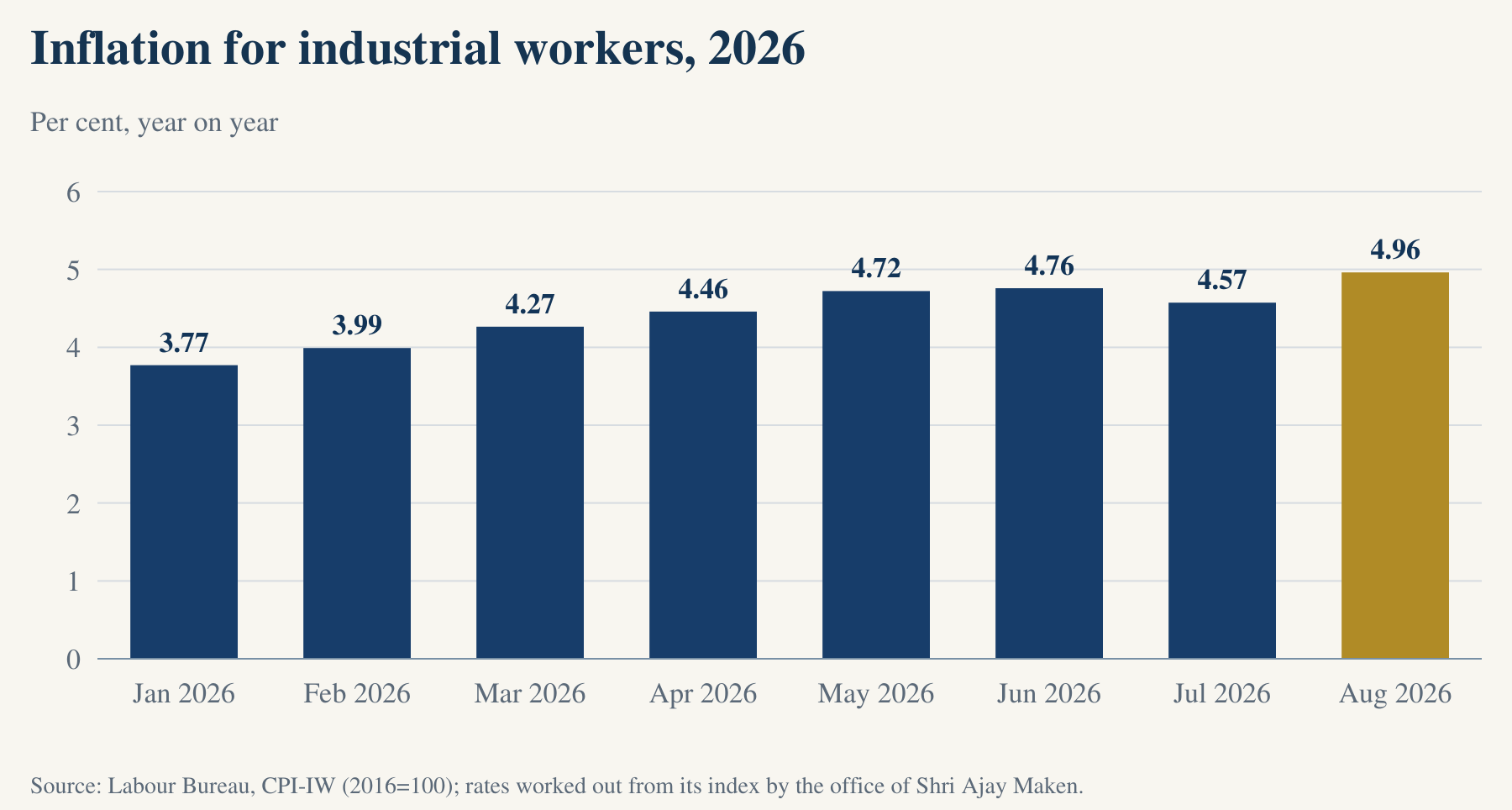
Source: Labour Bureau, release for August 2026, dated 30 September 2026 ; Reserve Bank, DBIE copy of the Bureau's index, read 11 October 2026 . Each observation's dated source is linked in its CSV row.
View the figures in a table
| Observation | Value | Official source |
|---|---|---|
| Jan 2026 | 3.77 | Reserve Bank, DBIE copy of the Bureau's index, read 11 October 2026 |
| Feb 2026 | 3.99 | Reserve Bank, DBIE copy of the Bureau's index, read 11 October 2026 |
| Mar 2026 | 4.27 | Reserve Bank, DBIE copy of the Bureau's index, read 11 October 2026 |
| Apr 2026 | 4.46 | Reserve Bank, DBIE copy of the Bureau's index, read 11 October 2026 |
| May 2026 | 4.72 | Reserve Bank, DBIE copy of the Bureau's index, read 11 October 2026 |
| Jun 2026 | 4.76 | Reserve Bank, DBIE copy of the Bureau's index, read 11 October 2026 |
| Jul 2026 | 4.57 | Reserve Bank, DBIE copy of the Bureau's index, read 11 October 2026 |
| Aug 2026 | 4.96 | Labour Bureau, release for August 2026, dated 30 September 2026 |
Food rose fastest in August
Food rose fastest in August. The food and beverages index climbed 2.4 points in one month, from 158.9 to 161.3, a rise of 1.51 per cent, and no other of the six groups rose as much.
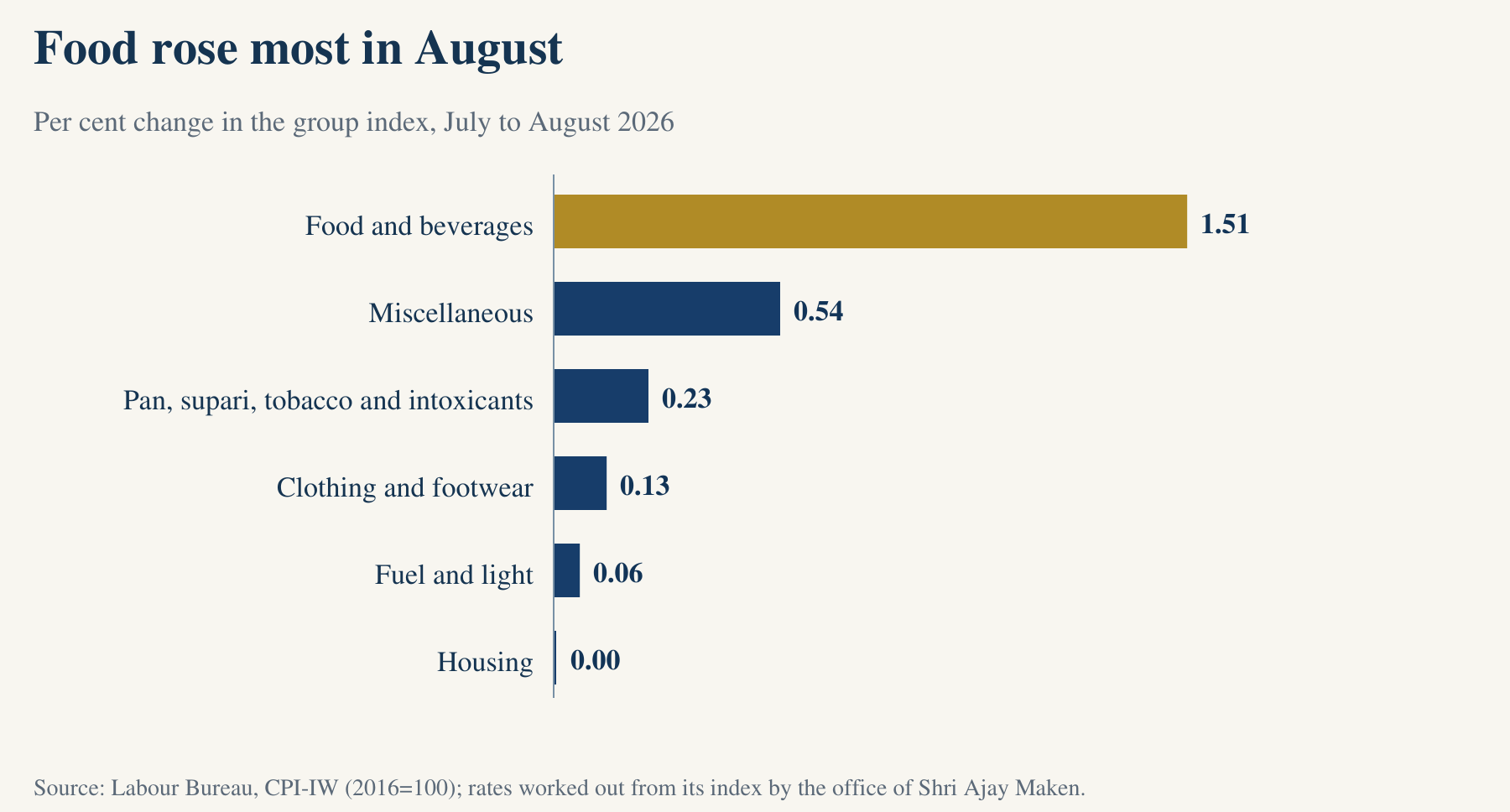
Source: Labour Bureau, release for August 2026, dated 30 September 2026 . Each observation's dated source is linked in its CSV row.
View the figures in a table
| Observation | Value | Official source |
|---|---|---|
| Food and beverages | 1.51 | Labour Bureau, release for August 2026, dated 30 September 2026 |
| Miscellaneous | 0.54 | Labour Bureau, release for August 2026, dated 30 September 2026 |
| Pan, supari, tobacco and intoxicants | 0.23 | Labour Bureau, release for August 2026, dated 30 September 2026 |
| Clothing and footwear | 0.13 | Labour Bureau, release for August 2026, dated 30 September 2026 |
| Fuel and light | 0.06 | Labour Bureau, release for August 2026, dated 30 September 2026 |
| Housing | 0.00 | Labour Bureau, release for August 2026, dated 30 September 2026 |
Food prices for these workers now stand 61.3 per cent above where they were in 2016, while the whole basket stands 54.4 per cent above it.
| Group | July 2026 | August 2026 | Change, per cent |
|---|---|---|---|
| Food and beverages | 158.9 | 161.3 | 1.51 |
| Miscellaneous | 148.2 | 149.0 | 0.54 |
| Pan, supari, tobacco and intoxicants | 176.9 | 177.3 | 0.23 |
| Clothing and footwear | 158.0 | 158.2 | 0.13 |
| Fuel and light | 159.9 | 160.0 | 0.06 |
| Housing | 143.0 | 143.0 | 0.00 |
| General index | 153.2 | 154.4 | 0.78 |
Source: Labour Bureau, release for August 2026, dated 30 September 2026 .
What it costs you
A basket that cost Rs 100 in August 2025 cost Rs 104.96 in August 2026. A basket that cost Rs 100 in 2016 cost Rs 154.40 in August 2026, and food that cost Rs 100 in 2016 cost Rs 161.30.
The Labour Bureau builds the index from retail prices that it collects in 317 markets, which are spread over 88 industrial centres across the country.
From March to August 2026 the cost of living for industrial workers rose in every month, and in August food rose faster than any other group of the things that they buy.
Terms, explained
- CPI-IW
- The Consumer Price Index for Industrial Workers is the Labour Bureau's measure of the prices that the families of industrial workers pay. The Bureau collects the prices in 317 markets, across 88 industrial centres.
- Rate of inflation
- The rate compares one month's index with the index of the same month a year earlier. A rate of 4.96 per cent means that prices were 4.96 per cent higher than a year before.
- Base 2016=100
- The Bureau sets the index at 100 for the year 2016. So a reading of 154.4 means that prices stand 54.4 per cent above their 2016 level.
- Groups
- The Bureau splits the basket into six groups: food and beverages; pan, supari, tobacco and intoxicants; clothing and footwear; housing; fuel and light; and everything else, which it calls miscellaneous.
Downloads for readers and the press
Sources & method
The Labour Bureau publishes the CPI-IW each month. Its release for August 2026, dated 30 September 2026, prints the index and the six group indices and gives the rates for August 2026 and August 2025.
The Reserve Bank of India keeps a copy of the Bureau's monthly index in a database that it calls the Database on Indian Economy. This brief uses that copy to work out each other month's rate, by dividing a month's index by the index of a year earlier and taking away one.
The Bureau's own chart prints the rate for each month since August 2025, and in all 13 of those months the rates worked out here match the Bureau's to two decimals. Every figure is rounded once, from the unrounded result.
Where the brief counts back beyond September 2020, it joins the older series to the present one using only the Bureau's own linking factors.
- Labour Bureau, release for August 2026, dated 30 September 2026 .
- Reserve Bank, DBIE copy of the Bureau's index, read 11 October 2026 .
- Labour Bureau, calendar of CPI-IW releases for 2026 .