The reversal on MoSPI’s own survey
The Periodic Labour Force Survey is the Government’s own survey of work. Each year it asks households what work every member did during the past year. The office recalculated the results from the survey’s unit records, and the calculation matches the published figure in all eleven releases checked.
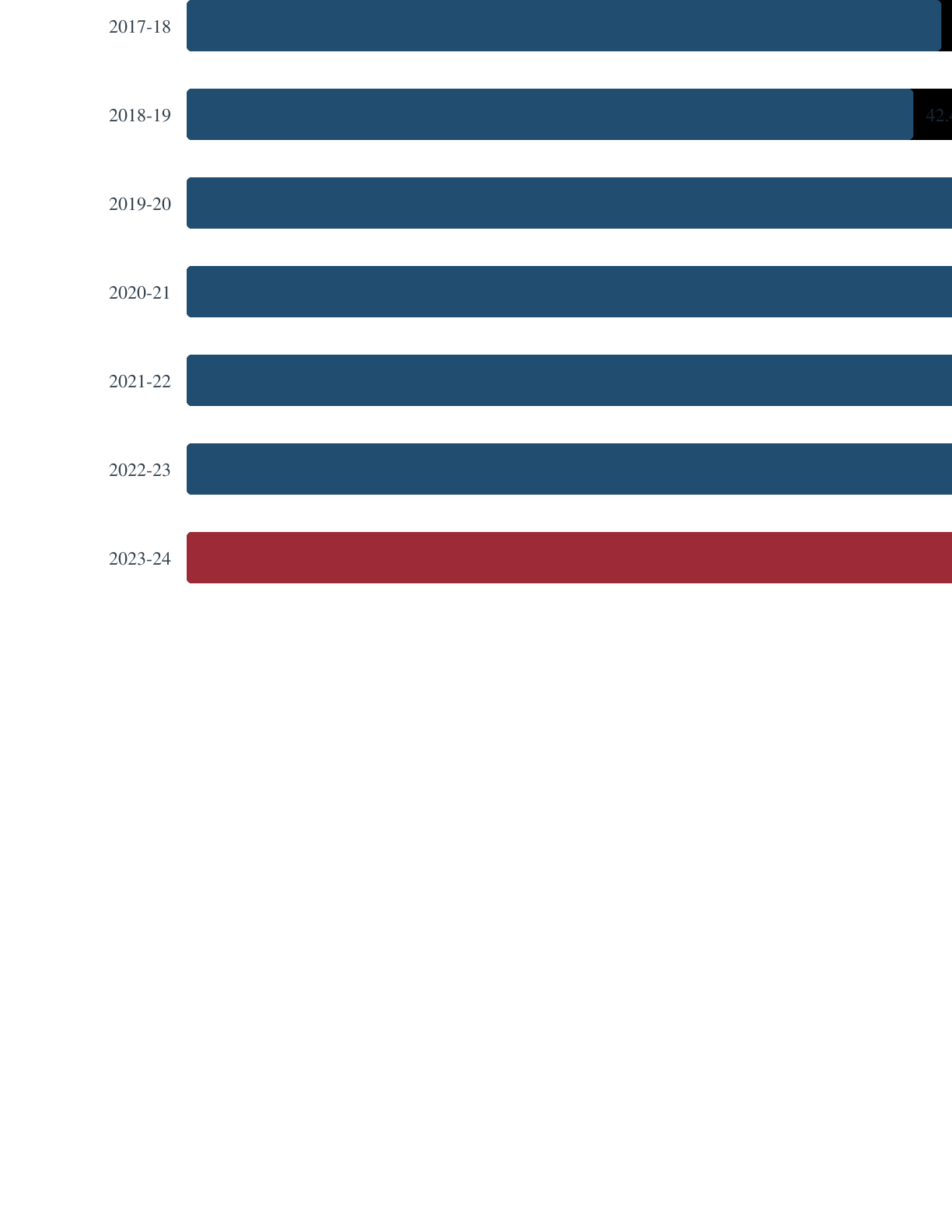
Between 2018-19 and 2023-24, agriculture’s share of India’s workers aged 15 and over rose from 42.47 per cent to 46.01 per cent, counting both main and subsidiary work, on MoSPI’s own PLFS unit records. Unpaid helpers on family farms account for more than the whole rise: their share of all workers went from 10.87 per cent to 16.33 per cent, while the share of all other farm workers fell from 31.61 per cent to 29.68 per cent.
Agriculture’s share of workers aged 15 and over rose from 42.47 per cent in 2018-19 to 46.01 per cent in 2023-24, an increase of 3.54 percentage points. Both are July to June survey years.
A family helper works on the household’s farm and earns no wage of their own. This brief counts such helpers among the workers. Each person is counted once. Both years use the same survey, the same age group and the same definition of farm work. So the two figures can be compared directly. The comparison is therefore fair. It rests on one survey. It does not rest on a mix of sources.
Source: MoSPI, Periodic Labour Force Survey unit records, 2017-18 to 2023-24 (office calculation) .
The same survey, read against its earlier rounds
Earlier rounds of the National Sample Survey cover 2004-05 to 2011-12. Their design differs from the design of the newer survey, so the two surveys are never compared level against level.
On MoSPI’s own surveys, each read within its own design, agriculture’s share of workers aged 15 and over fell by 9.48 points in the seven years from 2004-05 to 2011-12 (NSS, 58.32 to 48.84 per cent). It rose by about 1.9 points in the six years from 2017-18 to 2023-24 (PLFS, 44.11 to 46.01 per cent). The two surveys differ in design, so only the change within each survey is compared, and never a level across them.
Source: MoSPI, Periodic Labour Force Survey unit records, 2017-18 to 2023-24 (office calculation) .
China has moved workers out of agriculture much faster
ILO means the International Labour Organization. Its modelled estimates cover India and China on one basis. China’s share was 59.6 per cent in 1991 and 21.7 per cent in 2025. India’s share was 63.1 per cent in 1991 and 41.6 per cent in 2025.
On the same ILO modelled series, India’s 2025 agricultural share remained almost twice China’s. Both figures come from the same ILO modelled series, which Our World in Data publishes for India and China in one indicator.
The figures for 2025 are the latest in the series.
What RBI and Santosh Mehrotra estimate
A crore is ten million. These are estimates. Each one is attributed to its author. The brief does not present them as figures of the office. They are given so that the reader can see the range. Each estimate is credited to its source.
RBI’s KLEMS database of July 2024 puts agricultural employment at 20.28 crore in 2018-19 and 25.30 crore in 2022-23, a rise of 5.03 crore. Its industry series stops in 2022-23, and its provisional total for 2023-24 carries no agricultural figure.
In RBI’s KLEMS database, agriculture accounts for 48.3 per cent of the increase in persons employed between 2018-19 and 2022-23.
Santosh Mehrotra estimates about 200 million agricultural workers in 2019 and 280 million in 2024. Mehrotra says his estimate applies survey employment shares to the Government’s population projections; RBI’s figure comes from its KLEMS database of July 2024.
Source: Reserve Bank of India, India KLEMS Database, July 2024 ; Santosh Mehrotra, Non-Farm Jobs Have Grown At Half The Required Rate, Outlook Business, 1 October 2026 .
Downloads
Sources and terms
- Usual status
- A person is counted as working if they worked for most of the previous year, in a main or a subsidiary activity.
- Unpaid family helper
- A family member who works on the household’s farm or business and receives no wage of their own.
- MoSPI, Periodic Labour Force Survey unit records, 2017-18 to 2023-24 (office calculation) .
- Reserve Bank of India, India KLEMS Database, July 2024 .
- Santosh Mehrotra, Non-Farm Jobs Have Grown At Half The Required Rate, Outlook Business, 1 October 2026 .
- Our World in Data, Share of employment in agriculture, industry and services (ILO modelled estimates) .